
Why Your Bedroom Deserves Quiet (And How to Get It Without Breaking the Bank)
A DIY budget soundproof bedroom is easier to achieve than most people think. Here are the fastest ways to get started:
- Seal gaps around doors and windows with weatherstripping or acoustic caulk
- Hang thick curtains or moving blankets over windows and doors
- Add rugs and rug pads to hard floors to reduce impact noise
- Place bookshelves filled with books against noisy shared walls
- Use draft stoppers at the bottom of doors
- Build DIY acoustic panels using rockwool and fabric for under $25 each
- Run a white or brown noise machine to mask what you can’t fully block
Most people can make a noticeable difference spending just $50–$100.
Noise is a real problem. In England alone, there is one noisy neighbour complaint for every 160 people. Roughly 20% of people live in areas where traffic noise is loud enough to harm their health.
And the damage goes beyond annoyance.
Sounds above 40 decibels — like traffic or a TV in the next room — can break up your sleep cycles. Chronic noise raises cortisol levels, hurts concentration, and chips away at your well-being night after night.
The good news? You don’t need a contractor or a big budget to fight back.
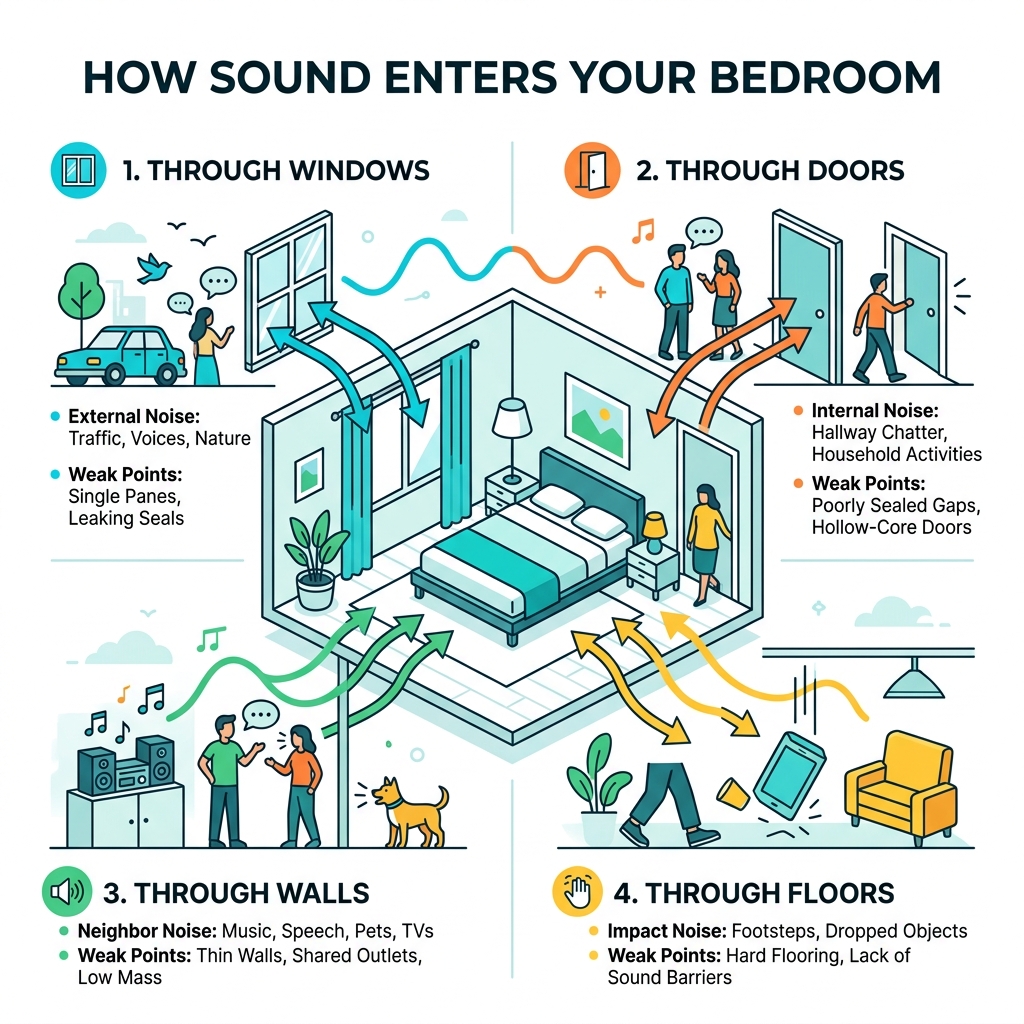
Most bedroom noise enters through the same weak points: gaps around doors, thin windows, bare walls, and hard floors. Fix those, and you’ll feel the difference fast.
This guide walks you through every practical, low-cost method — from sealing a door gap in five minutes to building your own sound-absorbing panels for a weekend project. No walls ripped out. No expensive professionals needed.
Understanding the Basics: Soundproofing vs. Sound Absorption
Before we grab the caulk gun, we need to clear up a common misunderstanding. In acoustics, “soundproofing” and “sound absorption” are two different beasts. If you use the wrong one for your specific noise problem, you’ll end up with a quiet room that still lets the neighbor’s bass through—or a loud room that just looks like a padded cell.
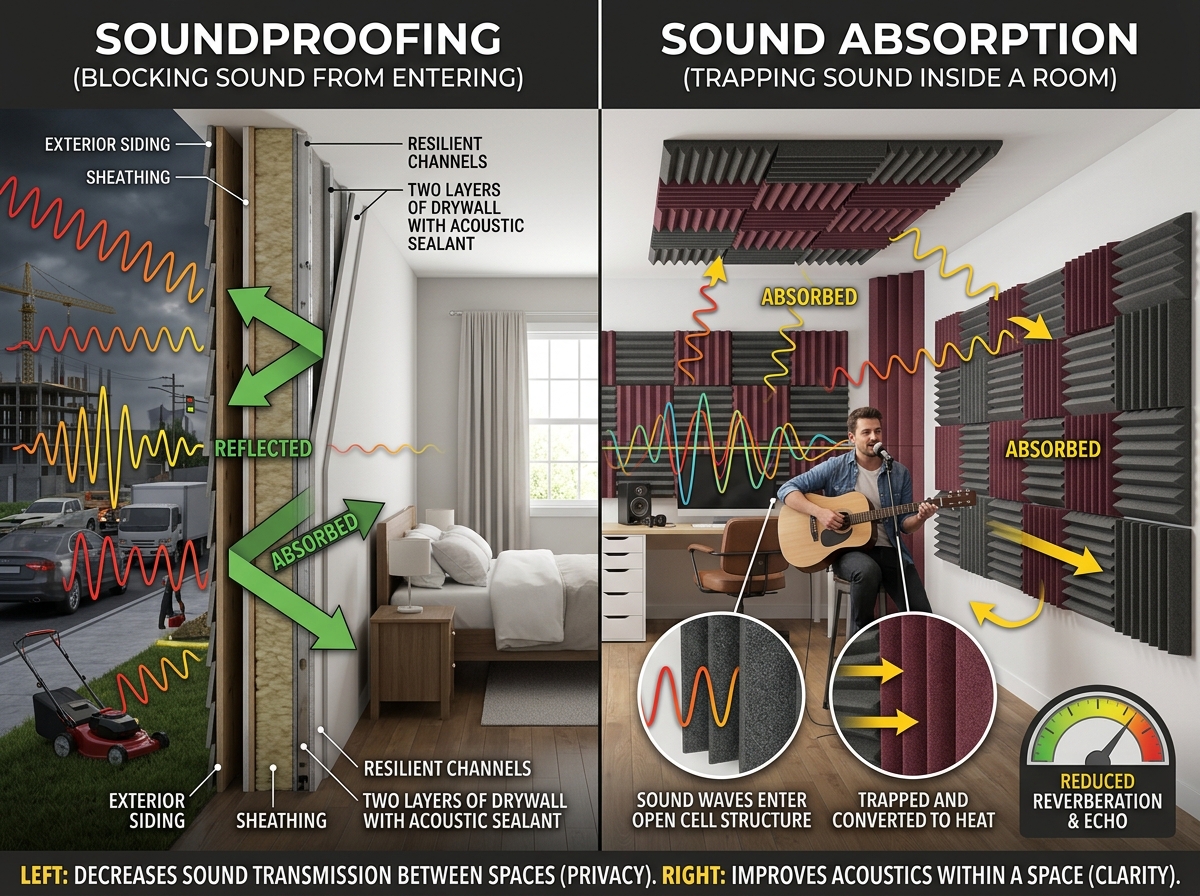
Soundproofing is about blocking sound from entering or leaving a space. This requires four core principles:
- Mass: Heavy, dense materials (like solid wood or thick drywall) that reflect sound waves.
- Decoupling: Creating a physical gap or “break” in the structure so vibrations can’t travel through the wall.
- Damping: Using compounds to dissipate sound energy as heat.
- Absorption: Trapping sound so it doesn’t bounce back.
Sound absorption (or acoustic treatment) is about improving the sound quality inside the room. It stops echoes and reverberations. While it makes a room feel “calmer,” it won’t stop a car horn outside from waking you up. For a truly effective How to Soundproof a Room for Music Practice: Complete DIY Guide, you usually need a combination of both.
At TechAvanco, we specialize in identifying cheap methods to absorb sound that also provide a modest level of isolation, ensuring you get the most bang for your buck.
Why the Distinction Matters for Your Budget
Understanding these terms saves you money. If your problem is airborne noise (talking, music, dogs barking), you need to seal air leaks and add mass. If your problem is impact noise (footsteps from upstairs, vibrations), you need decoupling and padding.
Spending $200 on thin egg-crate foam won’t block out your neighbor’s TV because it lacks the density to stop sound waves. However, using cheap methods to absorb sound-2 like heavy moving blankets or DIY rockwool panels can provide a noticeable 5–10 decibel drop for a fraction of the cost of professional “soundproof” tiles.
Identifying and Sealing Common Noise Entry Points
Sound is a lot like water; it will find the smallest hole and pour right through. We call this the 1% gap rule: a gap that accounts for just 1% of a surface area can leak up to 30% of the sound. If that gap increases to 5%, up to 90% of the sound can get through!
The first step in any DIY budget soundproof bedroom project is a “noise reconnaissance” mission. Close your door, turn off the lights, and look for light leaking in around the door frame or window. If light gets through, sound does too.
We recommend starting with easy diy soundproofing hacks like using acoustic caulk. Unlike regular silicone, acoustic caulk stays flexible for years, meaning it won’t crack as your house shifts, keeping the seal airtight. Pair this with easy diy soundproofing hacks-2 like high-density weatherstripping to turn your bedroom into a sealed vault.
Quick Fixes for Gaps and Cracks
Don’t overlook the small stuff. Here are three high-impact, low-cost fixes:
- Weatherstrip Foam Tape: Apply this to the “stop” of your door frame. When the door closes, it should compress the foam, creating a gasket seal.
- Door Sweeps and Draft Stoppers: The gap at the bottom of your bedroom door is a megaphone for hallway noise. A $10 rubber door sweep or a heavy fabric draft stopper can block up to 80% of hallway chatter.
- Electrical Outlets: Most people don’t realize that outlets are essentially holes in your sound barrier. Use foam outlet gaskets (the kind used for weatherization) to reduce noise bleeding through shared walls.
For more creative ideas, check out our guide on homemade methods for soundproofing.
DIY Budget Soundproof Bedroom: Windows and Doors
Windows and doors are almost always the “weakest links” in a room’s acoustic armor. Most interior doors are hollow-core, which act like drum chambers, amplifying sound rather than blocking it.
| Method | Estimated Cost | Noise Reduction | Renter Friendly? |
|---|---|---|---|
| Soundproof Curtains | $30 – $80 | 5–10 dB | Yes |
| Window Plugs (DIY) | $40 – $70 | 15–20 dB | Yes |
| Weatherstripping | $10 – $20 | 3–5 dB | Yes |
| Secondary Glazing | $100+ | 10–15 dB | No |
If you can’t afford a new solid-core door, blanket soundproofing a diy approach is your best bet. Hanging a heavy moving blanket over the door can dampen sound significantly for under $20.
Sealing Windows for a DIY Budget Soundproof Bedroom
Traffic noise is the enemy of deep sleep. If you have single-pane windows, you are likely hearing 20% of the population’s struggle with harmful noise levels.
To fix this on a budget, look into acoustic drapes. These aren’t just thick curtains; they are often made with multiple layers of heavy fabric (look for 12 oz to 18 oz/yd weight). For maximum effect, mount the rod 6 inches above the window and 4 inches past the sides to prevent sound from “leaking” around the edges.
Another fantastic option is a DIY window plug. This involves cutting a piece of Medium Density Fiberboard (MDF) or soundboard to fit snugly inside your window frame, backed with foam or rockwool. It’s essentially a removable wall you can pop in at night. We’ve detailed more bedroom noise reduction techniques on a budget to help you tackle these glass vulnerabilities.
Inexpensive Methods to Silence Bedroom Doors
If your budget allows, replacing a hollow door with a solid-core door (about $200) is the single best soundproofing investment you can make. However, for those of us on a tighter budget, we have to get creative.
Adding mass is key. You can attach a layer of Mass-Loaded Vinyl (MLV) or even cardboard soundproofing hacks for your studio techniques using multiple layers of dense honeycomb cardboard to the back of the door. While it’s not as pretty as a new door, it increases the density enough to stop the “drum” effect.
Affordable Wall and Ceiling Treatments
If you can hear your neighbor’s TV or the “thump-thump” of footsteps from above, it’s time to treat the larger surfaces. You don’t need to rip out drywall to see results.
One of the most effective DIY projects is building acoustic panels. For about $60–$130, you can build a set of four panels that would cost $400+ at a retail store.
- Build a simple frame using furring strips ($2 each).
- Fill the frame with rockwool or rigid fiberglass insulation.
- Wrap it in a breathable fabric like burlap or cheap muslin.
Follow our tutorial for building acoustic panels or the tutorial for building acoustic panels-2 for a step-by-step walkthrough.
Wall Hacks for a DIY Budget Soundproof Bedroom
If building panels isn’t your speed, there are simpler “mass-adding” hacks. Adding a second layer of drywall with Green Glue damping compound in between can slash noise by over 10 decibels, but that’s a permanent change.
For renters or those on a shoestring budget, try hanging a large, heavy tapestry or quilt. While it won’t block the neighbor’s shouting entirely, it will reduce the echo in your room, making the noise less “piercing.” You can also explore inexpensive diy wall panels for your studio and diy soundproofing acoustic panels for beginners for more renter-friendly wall treatments.
Soundproofing Floors and Ceilings on a Dime
Impact noise (footsteps) is the hardest to stop because it travels through the structure of the building.
- For Floors: A thick area rug is a good start, but the real magic happens with the rug pad. Use a felt or memory foam floor underlayment. A higher rug pile only accounts for a 2% reduction, but a dense pad can reduce footstep echo by 40–60%.
- For Ceilings: If you can’t convince your upstairs neighbor to buy a rug, you can install acoustic ceiling tiles or “acoustic clouds” (panels hung 2–3 inches below the ceiling). This creates a “sound trap” that catches noise before it reaches your ears.
Check out our affordable floor solutions for better soundproofing and affordable floor solutions for better soundproofing-2 for more deep dives into these techniques.
Repurposing Household Items for Sound Dampening
You might already own some of the best soundproofing tools. Maximalism is the champion of sound dampening. The more “stuff” you have in a room, the more surfaces there are to break up sound waves.
Bookshelves are the ultimate budget sound barrier. A wall-to-wall bookshelf filled with books adds massive amounts of mass and varied depths to a shared wall, which helps both block and diffuse sound. Wardrobes and large cupboards work similarly—place them against the wall where the noise is loudest.
Soft items like upholstered headboards, plush throw blankets, and even a closet full of clothes (which makes a great makeshift vocal booth!) all contribute to a quieter environment. If you’re looking for alternatives to expensive soundproofing foam, look no further than your linen closet.
Using White and Brown Noise to Mask Intrusions
Sometimes, you can’t block every decibel. That’s where frequency masking comes in.
- White Noise: Covers all frequencies equally. Great for general office hum or distant chatter.
- Brown Noise: Focuses on lower frequencies. It sounds like a deep rumble or a heavy waterfall. It is much more effective at masking low-end sounds like snoring, idling cars, or the “thud” of footsteps.
Using a fan or a dedicated machine can “raise the floor” of the silence in your room, making sudden noises less jarring to your nervous system. This is one of the most popular soundproofing tricks for small apartments.
Managing Expectations: Limitations of DIY Soundproofing
We want to be honest: a DIY budget soundproof bedroom will not be a 100% silent vacuum. Achieving total silence requires “room within a room” construction, which costs thousands.
However, by layering the methods above, you can realistically expect a 15 to 25 decibel reduction. To put that in perspective, a 10dB drop is perceived by the human ear as a halving of the volume. You can turn a 60-decibel street rumble into a 35-decibel whisper.
Be aware of flanking paths—sound traveling through air vents or floor joists. Even if your walls are perfect, noise might “flank” around them. Our guide on how to noise-proof your small studio on a budget covers how to identify these sneaky paths.
Frequently Asked Questions about DIY Bedroom Soundproofing
What is the cheapest way to soundproof a bedroom?
The absolute cheapest starting point is sealing air gaps. A $10 door sweep and $5 worth of weatherstripping can reduce noise by up to 30% instantly. After that, rearranging your furniture to put heavy items like bookshelves against noisy walls costs $0 and makes a massive difference.
Do egg cartons actually work for soundproofing?
In a word: No. This is a persistent myth. Egg cartons are too thin and light to block sound (mass) and too hard to absorb it effectively. They are essentially just flammable wallpaper. Save your eggs for breakfast and use moving blankets or rockwool instead.
Can I soundproof my bedroom if I am a renter?
Absolutely! Most of the techniques we’ve discussed—like soundproof curtains, rug pads, door sweeps, and freestanding acoustic panels—are completely non-destructive. You can take them with you when you move, making them a great long-term investment in your sleep.
Conclusion
At TechAvanco, we believe that everyone deserves a peaceful home, regardless of their budget. Achieving a DIY budget soundproof bedroom isn’t about buying the most expensive “pro” gear; it’s about understanding how sound moves and using practical, cost-effective materials to slow it down.
By sealing gaps, adding mass to your doors and windows, and using soft furnishings to kill echoes, you can significantly improve your home comfort and productivity. Silence isn’t just a luxury—it’s a vital part of your health and well-being.
For more tips on enhancing your living space without draining your wallet, check out our other guides. More info about DIY soundproofing is just a click away!
