
Why a DIY Wood Accent Wall Is Worth Every Nail
A DIY wood accent wall is one of the highest-impact, lowest-cost upgrades you can make to any room. Here’s what you need to know upfront:
Quick Answer: How to Build a DIY Wood Accent Wall
- Plan your design – choose a pattern (horizontal planks, vertical slats, geometric) and mock it up with painter’s tape or a free tool like Canva
- Calculate materials – measure your wall, divide by your board coverage, and add 10% for waste
- Prep your wall and wood – acclimate wood for 48-72 hours, locate studs, and paint the wall first
- Install your boards – use a level, consistent spacers, construction adhesive, and a brad nailer
- Finish the surface – fill nail holes, caulk seams, sand, then paint or stain
- Budget: Most projects cost under $100 and can be done in a weekend
So why do so many homeowners keep coming back to this project? Because it works. A wood wall adds texture, warmth, and a custom feel that plain paint simply can’t match. Research in biophilic design consistently shows that natural materials like wood make spaces feel more comfortable and calming — exactly what you want in a bedroom, living room, or home office.
The best part? You don’t need to be a carpenter. Many first-time DIYers — including complete beginners — have finished a full accent wall solo in a single weekend.
Whether you’re after cozy shiplap, a bold geometric pattern, or simple vertical slats, this guide walks you through every step.

Planning Your DIY Wood Accent Wall
Before we pick up a hammer, we need a plan. Walking into a hardware store without measurements is a recipe for three extra trips and a very frustrated afternoon. We always start by defining what the wall needs to do. Is it framing a TV? Elevating a headboard? Or perhaps acting as a backdrop for your home studio? If you are looking for inspiration for professional spaces, our guide on studio-wall-treatment-ideas can help spark some creativity.
Choosing a Pattern and Creating a Mockup
There are three main “flavors” of wood walls that most DIYers gravitate toward:
- Horizontal Planks (Shiplap Style): Classic, cozy, and makes a room feel wider.
- Vertical Slats: Modern and architectural. These make your ceilings feel miles high.
- Geometric Designs: Think chevrons, herringbone, or abstract angles. These are bold and act as the room’s main art piece.
To visualize these, we recommend using a digital mockup tool like Canva. You can upload a photo of your room and draw lines to see how different patterns fit the space. If you’re more “old school,” grab some painter’s tape and map out the design directly on the wall. This “dry run” reveals proportion issues early—like a board cutting right through an outlet in an awkward way.
Remember the 60/30/10 rule for a balanced room: 60% dominant color, 30% secondary color (your wood wall), and 10% accent colors. This ensures your diy wood accent wall complements the room rather than overwhelming it.
Calculating Materials and Budgeting
Math might not be the fun part of DIY, but it’s the most important. To find out how much wood you need, calculate the square footage of your wall (Height x Width).
- Pro Tip: One 4’x8′ sheet of plywood covers 4608 square inches.
- The 10% Rule: Always order 10% extra material. Between “oops” cuts and pattern adjustments, you’ll be glad you have the buffer.
If you’re on a tight budget, look into 1/4-inch plywood floor underlayment. It’s incredibly cheap, lightweight, and looks professional when ripped into strips and painted. For more budget-friendly ideas, check out our tips on inexpensive-diy-wall-panels-for-your-studio. A realistic budget for a 100-square-foot wall using plywood can be under $100, while premium hardwoods or tongue-and-groove boards might push you toward $200-$400.
Essential Tools and Materials for Success
Having the right tools is the difference between a project that looks “DIY” and one that looks “Designer.”
| Material Type | Best For | Pros | Cons |
|---|---|---|---|
| Plywood (1/4″) | Budget-friendly planks | Very cheap, lightweight | Needs sanding, no natural grain |
| MDF Strips | Geometric/Painted walls | Perfectly smooth, easy to cut | Heavy, not for staining |
| Tongue & Groove | Classic shiplap look | Easy to install, sturdy | More expensive, thicker |
| Pine/Poplar Slats | Modern vertical walls | Beautiful grain, easy to stain | Can warp if not acclimated |
Essential Tool Kit:
- Miter Saw: For clean, angled cuts.
- Brad Nailer: We recommend an 18-gauge nailer for invisible holes.
- Laser Level: Essential for keeping your lines straight across the whole wall.
- Stud Finder: You want to nail into the studs whenever possible.
- Construction Adhesive: Provides long-term stability so the boards don’t bow.
Best Wood Types for a DIY Wood Accent Wall
For a first-time project, we love pine and poplar. They are forgiving, easy to cut, and take paint well. If you want a natural wood look, birch plywood is a fantastic middle-ground—it has a beautiful, light grain but won’t break the bank.
If you are building your wall for more than just looks—say, to help with the acoustics of a noisy room—you might consider specific slat dimensions. Common setups include 1.5-inch wide slats with 0.75-inch gaps. For those interested in the functional side of wall treatments, we have a great tutorial-for-building-acoustic-panels that uses similar woodworking skills.
Necessary Preparation Steps
Preparation is where the pros shine. First, acclimate your wood. Bring the boards into the room where they’ll be installed and let them sit for 48-72 hours. Wood is a natural material that expands and contracts based on humidity; if you skip this, your beautiful wall might buckle or gap a month later.
Next, prep the wall:
- Clean it: Wipe down dust so the adhesive sticks.
- Mark the studs: Use a pencil or chalk line to mark every stud from ceiling to floor.
- Paint the wall: If you are doing a slat wall or shiplap with gaps, paint the wall the final color (or a dark contrasting color) before you put the wood up. It is nearly impossible to paint behind the gaps later!
For more detailed prep on wall surfaces, see our step-by-step-guide-diy-acoustic-foam-panels.
Step-by-Step Installation Guide
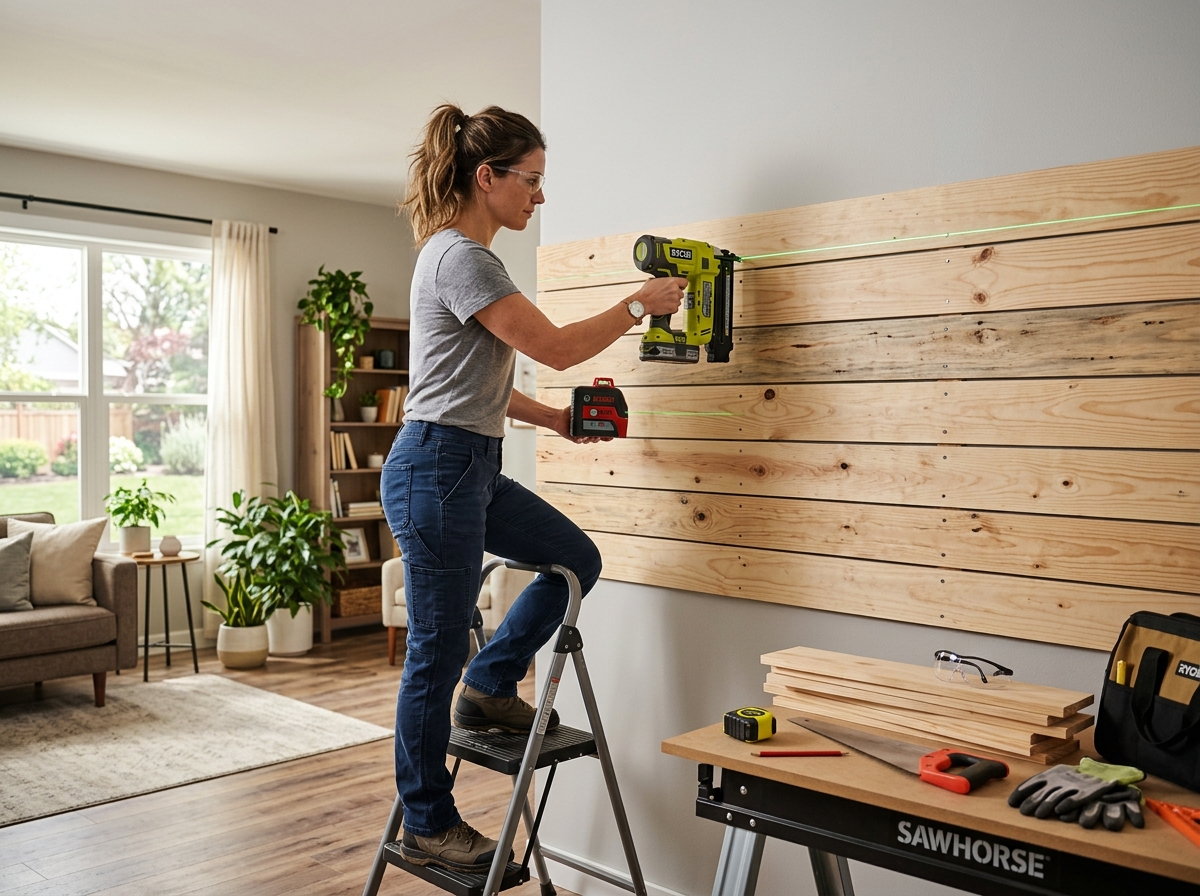
Now for the exciting part: making the vision a reality. Whether you start from the top or the bottom depends on your design. For horizontal planks, starting at the top is often better because any “wonky” cuts needed for unlevel floors will be hidden behind the baseboard at the bottom.
If you’re feeling nervous, even experienced DIYers sometimes have to “fudge” a measurement. For more beginner-friendly advice on wall projects, our diy-soundproofing-acoustic-panels-for-beginners guide offers a low-pressure way to practice your skills.
Installing Your DIY Wood Accent Wall Planks
- The First Board: This is the most important board you’ll ever install. Use your laser level to ensure it is perfectly plumb (vertical) or level (horizontal). If the first one is crooked, every board after it will be too.
- Adhesive Strategy: Apply a heavy-duty construction adhesive to the back of the board in an “S” pattern or small circles. This ensures the board stays flat against the wall.
- Nailing: Fire your brad nails into the studs you marked earlier. Two nails per stud usually does the trick.
- The Spacer Trick: Don’t measure the gap between every board. Use a “spacer stick”—a scrap piece of wood cut to your desired gap width—or even a nickel or dime for smaller shiplap gaps. This keeps everything consistent and fast.
Check out How To Build A Wood Accent Wall | Easy DIY Tutorial for a great visual on how tongue-and-groove boards lock together. For more on securing panels to walls, see our tutorial-for-building-acoustic-panels-2.
Dealing with Outlets and Obstacles
Outlets are the “boss fight” of a diy wood accent wall. Don’t be intimidated!
- Measure twice: Measure the distance from the last board to the outlet and mark it on your new board.
- The Jigsaw: Use a jigsaw to cut out the rectangular hole.
- Box Extenders: Because you’ve added thickness to the wall, your outlet is now recessed. You must use UL-listed box extenders to bring the outlet flush with the new wood. This is a vital safety step to prevent fires.
- Spacers: You can also use small plastic outlet spacers to keep the switch from wiggling.
For more technical tips on integrating wall features, our tutorial-for-building-acoustic-panels-3 covers how to work around various wall obstacles.
Professional Finishing Touches and Integration
The difference between a “weekend project” and a “professional renovation” is in the finishing. If you leave nail holes and raw seams, the wall will look unfinished.
Achieving a Flawless Surface
- Fill the Holes: Use wood putty or spackle for every nail hole. Once dry, sand it flush with 120-grit and then 220-grit sandpaper.
- Caulk the Edges: Run a bead of paintable caulk where the wood meets the ceiling, the corners, and the baseboards. This hides micro-gaps and makes the wall look like it grew there.
- Sanding: Give the whole wall a light sand before painting or staining to remove any splinters or rough edges.
- Paint or Stain:
- For Paint: Use a foam roller for a smooth finish. Pre-primed MDF is a dream for this.
- For Stain: Always use a wood conditioner first! It prevents the stain from looking blotchy, especially on softwoods like pine.
According to How to Make a DIY Wood Accent Wall on a Budget , using a paint sprayer can give you a factory-smooth finish if you have one available.
Integrating Lighting and Furniture
A wood wall is a texture-rich feature, and texture loves light.
- Wall Grazers: Install recessed lighting or track lights close to the wall to “graze” the surface. This creates shadows that highlight the depth of the wood.
- Color Temperature: Aim for 2700K to 3000K bulbs. This warm light enhances the natural tones of the wood, making the room feel cozy rather than clinical.
- Furniture: Ensure you have proper clearances for headboards or media units. A dark walnut wall looks incredible behind a mid-century modern dresser.
- TV Integration: If you’re mounting a TV, add bias lighting (LED strips) behind the screen. This reduces eye strain and makes the TV look like it’s floating against the wood.
For more ideas on how to style your space, visit studio-wall-treatment-ideas-2.
Frequently Asked Questions about Wood Accent Walls
What is the cheapest wood to use for an accent wall?
The most budget-friendly option is 1/4-inch plywood underlayment (often called “Luan” or “Revolution Ply”). You can buy a 4×8 sheet for about $15-$25 and have the hardware store rip it into strips for you. It’s perfect for a painted shiplap or geometric look.
How long does it take to complete a DIY wood wall?
Most straightforward projects take a weekend. We usually spend Saturday morning prepping and cutting, Saturday afternoon installing, and Sunday finishing (putty, sanding, and painting). Geometric patterns can take longer—sometimes upwards of 10 to 15 hours—because of the complex angled cuts.
Do I need to use glue and nails for installation?
For a permanent, professional-grade wall, yes. The construction adhesive does the heavy lifting to prevent the wood from warping over time, while the brad nails act as “clamps” to hold the wood in place while the glue dries. If you’re a renter, you might consider “peel and stick” options, but for a durable DIY wall, the glue-and-nail combo is king.
Conclusion
Creating a diy wood accent wall is more than just a home improvement project; it’s a way to bring character and a sense of calm into your living space. At TechAvanco, we believe that enhancing your home shouldn’t require a second mortgage. By using cost-effective materials like plywood and taking the time to prep correctly, you can achieve a high-end look on a modest budget.
Whether you’re looking to improve the “vibes” of your living room or seeking the biophilic benefits of natural textures, a wood wall is a fantastic place to start. Ready to take your DIY skills even further? Start your DIY journey with our soundproofing guides and learn how to make your home as quiet as it is beautiful. Happy building!
