
Why Street Noise Keeps You Awake — And What Actually Helps
Soundproof window inserts are custom-fit panels of acoustic acrylic that press into your existing window frame, creating an extra barrier that blocks outside noise without replacing your windows.
Here’s a quick look at what they do:
- Reduce noise by up to 70–80% depending on the grade and air gap
- Install in minutes — no tools, no drilling, no contractors
- Cost far less than window replacement — averaging around $372 per window vs. $450–$766 for replacements
- Add thermal insulation — most users see around 20% lower heating and cooling bills
- Work in rentals and historic homes — no permanent changes to the frame
If you live near a busy street, you already know the problem. Traffic rumble, sirens, and the general hum of city life don’t stop at your walls. And unfortunately, windows are the weakest link in almost any exterior wall when it comes to sound.
Even double-pane windows — the kind most people assume are solid performers — let in a surprising amount of noise. Standard windows often carry an STC (Sound Transmission Class) rating as low as 24 to 27. That’s enough to hear conversations clearly from outside.
The good news? You don’t need to tear out your windows to fix this.
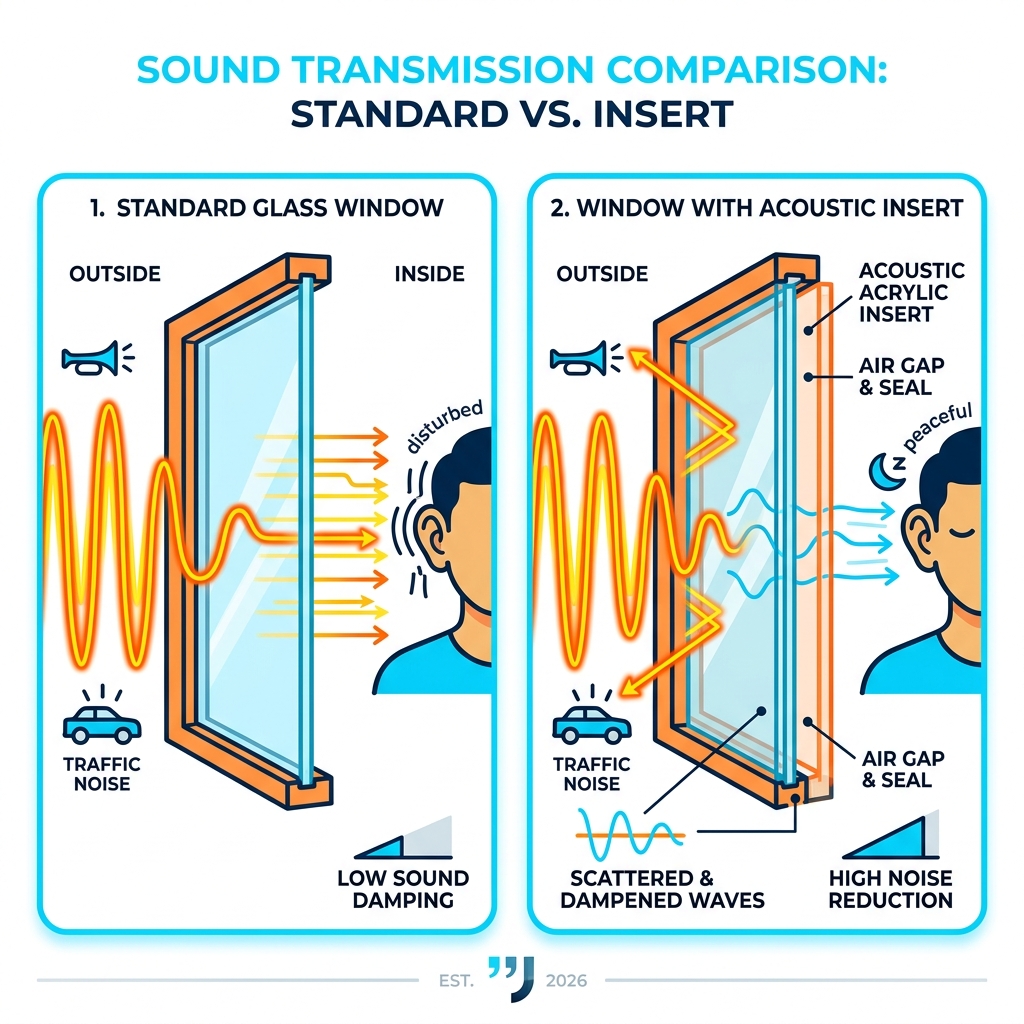
Soundproof window inserts are a practical, budget-friendly solution that slides in front of your existing glass. They create a second layer separated by an air gap — and that gap is what does the heavy lifting acoustically. The result can be a dramatic drop in the noise reaching your ears, often enough to sleep through what used to wake you up.
What Are Soundproof Window Inserts and How Do They Work?
At their core, soundproof window inserts are secondary glazing panels typically made from high-grade acrylic. Unlike traditional storm windows that sit on the outside of your house, these are designed for interior installation. They press into the existing window “jamb” (the interior frame) and stay there using compression or magnetic seals.
But how does a thin sheet of acrylic stop a semi-truck’s rumble? It comes down to three scientific principles: mass, the air gap, and the airtight seal.
- Mass and Vibration Damping: Sound is essentially vibration traveling through the air. Standard glass is thin and rigid, making it easy for sound waves to “wiggle” the pane and pass through. Acoustic-grade acrylic is denser and more flexible than glass, which helps dampen these vibrations before they reach your room.
- The Dead Air Gap: When we install an insert, we create a pocket of air between the existing window and the new panel. This air gap acts as a “sound trap.” As sound waves hit the first pane of glass, they lose energy. They then have to travel through the air gap and hit the second barrier (the insert), losing even more energy in the process.
- The Airtight Seal: This is the most critical part. If air can get through, sound can get through. High-quality inserts use compression tubing or magnetic strips to create a seal that is nearly 100% airtight. This prevents “sound leaks” that often occur around the edges of old, drafty windows.

In acoustics, we measure effectiveness using the STC (Sound Transmission Class) rating. A higher number means better noise blocking. A standard double-hung window might have an STC of 24. Adding a high-performance acoustic insert can jump that rating to 37 or even 49. To your ears, a 10-point increase in STC sounds like a 50% reduction in noise.
If you are looking for more window soundproofing solutions that won’t break the bank, inserts are often the gold standard because they provide professional-level results without the professional-level price tag.
Comparing Performance: Inserts vs. Replacement Windows
We often get asked: “Shouldn’t I just buy new triple-pane windows?” While new windows are great for a full home renovation, they are rarely the best choice if your primary goal is silence.
Replacement windows are expensive, messy to install, and—surprisingly—often less effective at soundproofing than a simple insert. This is because most replacement windows are designed for thermal efficiency (keeping heat in), not acoustic isolation. Even a triple-pane window often has very small air gaps between the glass layers, which doesn’t do much to stop low-frequency traffic noise.
| Feature | Soundproof Window Inserts | Replacement Windows (Double/Triple) |
|---|---|---|
| Noise Reduction | Up to 70–80% (STC 49+) | Approx. 25–35% |
| Average Cost | ~$372 per window | $450 – $766+ per window |
| Installation | DIY-friendly (minutes) | Professional required (days) |
| Historic Homes | Preserves original look | Often prohibited by codes |
| Air Gap | Customizable (2″ to 6″+) | Fixed and narrow |
As the table shows, soundproof window inserts offer a better Return on Investment (ROI). Because they are removable, they are also the only real option for historic homes where you aren’t allowed to change the exterior facade. You get the quiet of a modern studio while keeping the charm of your 100-year-old wooden frames.
The Multi-Benefit Advantage: Insulation and Protection
While we usually talk about quiet, these inserts are secret weapons for home efficiency. Because they create an airtight seal, they act as high-performance interior storm windows.
- Thermal Insulation & Energy Savings: By stopping drafts and adding a second layer of insulation, inserts can reduce energy transfer through your windows by over 60%. On average, homeowners see a 20% saving on their heating and cooling bills. It’s one of the few soundproofing upgrades that actually pays for itself over time.
- UV Protection: Many acoustic inserts are treated to block up to 98% of UV rays. This prevents your furniture, rugs, and artwork from fading in the sun.
- Condensation Prevention: If you have “sweaty” windows in the winter, inserts can help. By keeping the warm indoor air away from the cold glass, they significantly reduce condensation and the mold issues that come with it.
- Pollen and Pollutant Blocking: For allergy sufferers, that airtight seal is a lifesaver. It keeps out seasonal pollen, dust, and even street smog that typically leaks through window gaps.
Measuring and Installing Your Custom Solution
One of the reasons we love this solution at TechAvanco is that it is truly DIY-friendly. You don’t need a contractor, a permit, or even a hammer. However, the performance of your soundproof window inserts depends entirely on a “snug fit.”
Measuring for Custom Soundproof Window Inserts
Because houses settle over time, windows are rarely perfectly square. If you measure just the top and bottom, your insert might not fit the middle.
To ensure a perfect fit (many top brands boast a 99% success rate), we recommend using a laser measure. Many companies provide a measurement kit that includes a laser and proprietary software to record the dimensions at multiple points along the frame. You’ll want to measure the height and width in at least three places each. This ensures the custom-cut acrylic accounts for every slight curve or tilt in your window jamb.
DIY Installation of Soundproof Window Inserts
Once your custom panels arrive, the installation is a breeze. Here is the general process:
- Clean the Area: Wipe down your existing window and the interior frame. You won’t be touching the “inside” of this gap for a while, so you want it crystal clear.
- Prep the Insert: Peel off the protective film from the acoustic acrylic.
- The Press Fit: Most inserts use a compression tube around the edge. You simply align the insert with the frame and press it into place. Start at the bottom and work your way up.
- Check the Seal: Run your finger along the edge to ensure the tubing is compressed against the frame.
For seasonal maintenance, you can use a small handle or a D-ring (usually provided) to pop the insert out. This is important for cleaning or if you want to open the windows for a breeze during the spring. In case of an emergency, these inserts are designed for quick “egress,” meaning they can be removed in seconds if you need to exit through the window.
Frequently Asked Questions
Do inserts block low-frequency traffic noise?
Yes, but the depth of the air gap is key. While standard inserts block high-frequency sounds (like birds or voices) very well, low-frequency sounds (like the “thrum” of a bus engine) require more space. If you have a deep window sill, mounting the insert further away from the glass (creating a 4.5″ to 6.5″ air space) can achieve an STC of 51, which is effective even against heavy traffic rumble.
Are window inserts suitable for apartments or historic homes?
They are perfect for both. Since most designs require no screws or glue, they are 100% renter-friendly. You can take them with you when you move! For historic homes, they are often the only approved way to improve performance because they are invisible from the street and don’t damage the original woodwork.
How much do custom inserts typically cost?
Pricing usually ranges from $27 to $40 per square foot. For a standard-sized window, you can expect to pay around $324 to $480. While this is an investment, many companies offer bulk discounts if you are doing a whole bedroom or a full house. Compared to the $700+ cost of a high-end replacement window, the savings are substantial.
Conclusion
At TechAvanco, our mission is to provide you with practical, cost-effective ways to reclaim your home’s comfort. Living on a busy street shouldn’t mean sacrificing your sleep or your sanity. Soundproof window inserts represent the perfect intersection of high-tech acoustic science and low-effort DIY installation.
By choosing inserts, you aren’t just blocking noise; you’re lowering your energy bills, protecting your furniture from UV damage, and creating a peaceful sanctuary in the middle of the city. If you’re ready to take the next step in quietening your space, check out more info about DIY soundproofing to see how you can transform your home one room at a time.
