
The Best Sound Absorbing Panels for Your Bedroom
Why Sound Absorbing Bedroom Panels Are Worth Your Attention
Sound absorbing bedroom panels are one of the most practical and affordable ways to cut down on noise and echo in your sleeping space. Here are the top picks to get you started:
Best sound absorbing bedroom panels at a glance:
| Panel Type | Best For | Price Range | NRC Rating |
|---|---|---|---|
| Acoustic foam wedges/tiles | Budget buyers, echo reduction | $17 – $50 | ~0.4 |
| Fabric-wrapped panels | All-around absorption, aesthetics | $50 – $200 | 0.85 – 1.05 |
| Wood slat panels | Decorative feature walls | $100 – $300 | 0.75+ |
| Freestanding partitions | Renters, no-drill setups | $110 – $440 | ~0.30 |
| Custom art panels | Style + performance | $100 – $200+ | 1.05 |
If you share a wall with noisy neighbors, live near a busy street, or just can’t seem to shake that hollow echo when you talk in your room — you’re not alone. Bedroom noise is one of the most common complaints among renters and homeowners alike.
The good news? You don’t need a full renovation to fix it.
Sound absorbing panels work by trapping sound waves inside porous materials, converting acoustic energy into a tiny amount of heat. That means less echo, less reverberation, and a calmer, quieter room overall. They won’t block all outside noise entirely — that’s a different job — but they make a real, noticeable difference for most bedroom noise problems.
Panels rated with a high NRC (Noise Reduction Coefficient) absorb more sound. A rating of 1.0 means the material absorbs nearly all sound that hits it. Budget foam panels typically score around 0.4, while premium fabric-wrapped or hemp core panels can reach 1.05.
Whether you’re spending $20 or $200, there’s an option that fits your space, your style, and your budget.
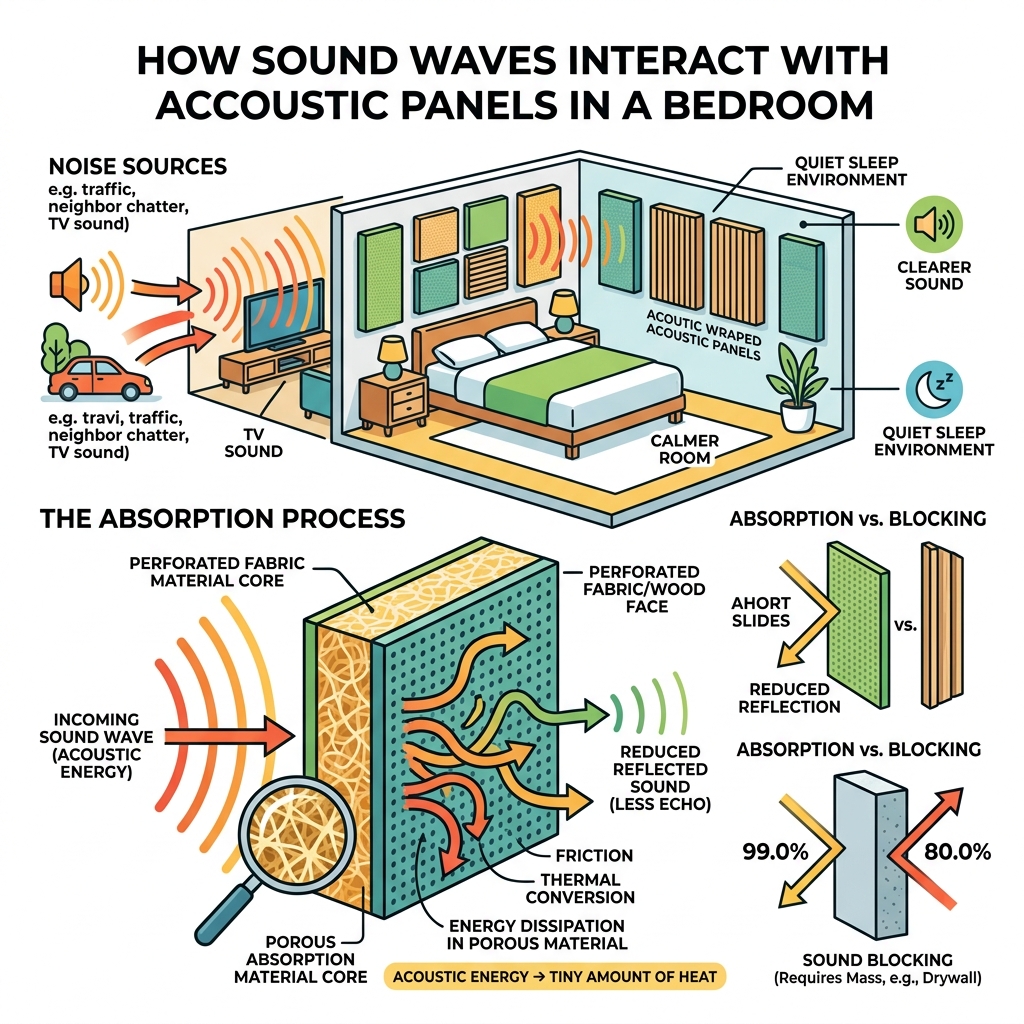
Sound Absorption vs. Soundproofing: Understanding the Difference
Before we dive into the products, we need to clear up a common misunderstanding. In acoustics, “sound absorption” and “soundproofing” are two very different tools.
If your goal is to stop the sound of a leaf blower outside from entering your room, you are looking for soundproofing. This requires adding mass (like thick drywall or lead-lined curtains) to block sound transmission. However, if your goal is to stop your voice from echoing, make your TV sound clearer, or dampen the “chatter” coming through a shared wall, you need sound absorption.
The Science of Silence
Acoustic panels work through a process of energy conversion. When a sound wave hits a hard surface like a bedroom wall, it bounces back, creating an echo. When that same wave hits a porous material—like the AuraPanel™ Wall Panels—the fibers trap the wave. The friction between the sound wave and the panel fibers converts that acoustic energy into kinetic energy or a tiny amount of heat.
To measure how well a panel does this, we look at the NRC (Noise Reduction Coefficient).
- NRC 0.0: Reflects all sound (like a mirror).
- NRC 1.0: Absorbs all sound (like an open window).
Most high-performance panels actually exceed 1.0 at certain frequencies. For example, some professional-grade panels reach an NRC of 1.05, meaning they are incredibly efficient at “conditioning” the sound in your room to be softer and more intimate. If you’re looking for more info about bedroom noise reduction techniques, absorption is about quality, while proofing is about quantity.
Top Types of sound absorbing bedroom panels for Every Style
Choosing the right sound absorbing bedroom panels depends on your interior design as much as your noise issues. You don’t want your sanctuary to look like a padded cell!

Material Performance Comparison
| Material | Thickness | Best Frequency Range | Style Factor |
|---|---|---|---|
| Acoustic Foam | 1″ – 2″ | High frequencies (treble) | Industrial/Studio |
| Mineral Wool | 2″ – 4″ | Broadband (all frequencies) | Modern/Clean |
| Polyester Felt | 0.3″ – 0.5″ | Mid-high frequencies | Sleek/Minimalist |
| Hemp Core | 3.5″ | Excellent low-mid range | Eco-luxury |
For those of us who prioritize sustainability, Sustainable hemp core panels are a fantastic choice. They are safe to touch (unlike some fiberglass options) and use US-grown hemp wool to provide professional-level absorption.
Decorative sound absorbing bedroom panels for Aesthetics
You shouldn’t have to sacrifice style for sleep. Modern designs have turned acoustic treatment into a luxury decor element.
- Wood Slat Panels: These are the current darlings of interior design. They feature real wood veneers (like walnut or oak) mounted on a thick recycled polyester felt backing. The gaps between the slats help diffuse sound, while the felt absorbs it.
- Seamless Patterns: Products like the VicPattern seamless design use musical rhythm-inspired patterns that look like high-end 3D wallpaper but pack a serious acoustic punch.
- Acoustic Wall Art: This is our favorite “hidden” solution. You can get Acoustic wall art panels that look exactly like a canvas painting or a custom photograph. The image is printed on acoustically transparent fabric, so the sound passes right through to the absorbent core inside.
Budget-Friendly sound absorbing bedroom panels
If you’re looking for a cost-effective fix, acoustic foam is the way to go. You can find 12-packs or even 52-packs on sites like Amazon for under $50. These are typically wedge or pyramid-shaped tiles that are easy to install with self-adhesive strips.
While foam isn’t as effective at stopping low-frequency thumps (like a neighbor’s bass), it’s excellent at removing the “hollow” sound from a room. We’ve written a guide on using foam panels effectively to help you avoid over-treating your room. If you’re feeling crafty, you can even look into inexpensive DIY wall panels to save even more.
Strategic Placement for Maximum Noise Reduction
Where you put your sound absorbing bedroom panels is just as important as which ones you buy. You don’t need to cover every inch of your walls; in fact, covering about 25% of the hard surfaces is usually enough to notice a massive difference.
The First Reflection Point
In a bedroom, sound often bounces off the wall directly opposite your bed or your TV. Placing panels at these “first reflection points” stops the sound from bouncing back and forth.
- Shared Walls: If you hear your neighbors talking, place a cluster of panels on the wall you share with them. This won’t “stop” the sound from coming through, but it will absorb the sound as it enters your room, making it less intrusive.
- Near Windows: Traffic noise often leaks through window frames. Placing thick, fabric-wrapped panels on the wall sections surrounding the window can help dampen the ambient hum.
- The Headboard: A popular DIY move is mounting wood slat panels or fabric panels directly behind the bed. This creates a cozy “sonic cocoon” around your pillows.
- Ceiling Clouds: If you have high ceilings, sound can “flutter” above you. Suspending panels from the ceiling (known as clouds) is a pro-level move for total silence.
For more tips on the basics of installation, check out our guide on DIY soundproofing for beginners.
DIY Alternatives and Maintenance for Long-Term Use
At TechAvanco, we love a good project. If commercial panels are outside your budget, you can build your own using a wooden frame, some mineral wool or rigid fiberglass, and a breathable fabric. We have a full tutorial for building acoustic panels that walks you through the process.
Creating Bass Traps
Low-frequency sounds (like a snoring partner or a humming air conditioner) are the hardest to catch. Standard thin panels won’t do much here. You need “bass traps,” which are thicker panels usually placed in the corners of the room where bass energy tends to build up. Learn the secrets of creating your own bass traps to round out your bedroom’s acoustic treatment.
Maintenance Tips
Once your panels are up, they require very little work.
- Vacuuming: Use a soft brush attachment on your vacuum once a month to remove dust from fabric-wrapped panels.
- Cleaning Wood Slats: A damp cloth is all you need for wood veneers. Avoid harsh chemicals that might damage the finish.
- Durability: Most high-quality panels are made from recycled plastics or sustainable fibers that won’t degrade over time. They are a one-time investment in your sleep quality.
Frequently Asked Questions about Bedroom Acoustics
Do acoustic panels block noise from neighbors?
Not entirely. As we mentioned, panels are for absorption, not blocking. They will reduce the echo of the neighbor’s noise once it enters your room, making it sound “further away” and less sharp. For total silence, you would need to add mass to the wall itself.
How many panels do I need for a typical bedroom?
A good rule of thumb is the 25% rule. Calculate the total square footage of your walls and aim to cover about 25% of that area with panels. For a standard 10×12 bedroom, that’s roughly 110 square feet of wall space, meaning you’d want about 25-30 square feet of panels.
Are acoustic panels safe for residential use?
Yes, provided you check the fire ratings. Look for Class A fire-rated materials. Most reputable brands use non-toxic, formaldehyde-free materials like polyester felt or mineral wool that are perfectly safe for a sleeping environment.
Conclusion
At TechAvanco, we believe that a quiet bedroom is the foundation of a productive life. Investing in sound absorbing bedroom panels isn’t just about acoustics; it’s about sleep hygiene and mental well-being. Whether you choose a high-end wood slat design or a budget-friendly DIY foam setup, the reduction in ambient stress is well worth the effort.
Ready to take your home setup to the next level? Explore more recording setup guides to see how acoustic treatment can transform any space in your house. Sleep tight!
