
Why Acoustic Internal Doors Make a Real Difference to Home Comfort
Acoustic internal doors are specially designed doors that block noise from passing between rooms — and they work far better than the standard hollow-core doors found in most homes.
Quick answer: What are acoustic internal doors?
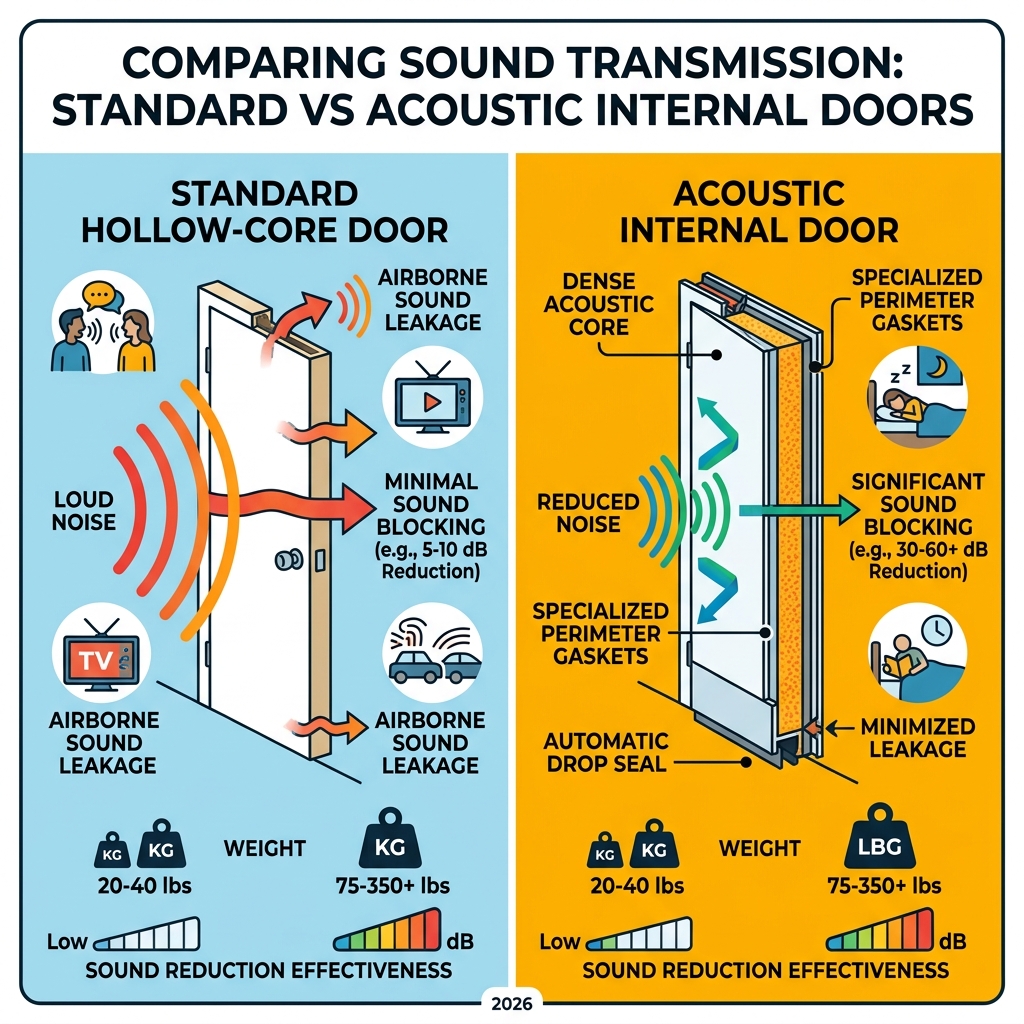
| Feature | Standard Door | Acoustic Internal Door |
|---|---|---|
| Core | Hollow or basic solid | Dense, multi-layer acoustic core |
| Weight | 20–40 lbs | 75 lbs to 350+ lbs |
| Sound reduction | Minimal (5–10 dB) | 30 dB to 60+ dB |
| Seals | None or basic | Perimeter gaskets + drop seals |
| Best for | General use | Bedrooms, offices, studios |
If noise is bleeding through your bedroom door at night — traffic, TV, voices — a better door can make a surprising difference. Most people assume walls are the problem. Often, it’s the door.
Standard hollow-core doors offer almost no real noise protection. Even a basic solid-core door is better, but purpose-built acoustic doors go much further. They use heavy-density materials, specialized seals on all four sides, and engineered cores to stop sound in its tracks.
The good news: you don’t need a recording studio budget to see results. There’s a wide range of acoustic internal doors available — from affordable 30 dB options suited to bedrooms and home offices, all the way up to professional-grade 55–60 dB doors for studios and commercial spaces.
This guide breaks down exactly how these doors work, what the ratings mean, and how to choose the right one for your situation and budget.
Understanding the Science of Acoustic Internal Doors
To understand why acoustic internal doors are so effective, we first have to look at how sound behaves. Sound is essentially a pressure wave traveling through the air. When that wave hits a standard door, it does two things: it vibrates the door (passing the sound through to the other side) and it leaks through any tiny gaps around the edges.
Effective soundproofing relies on four main pillars: mass, damping, decoupling, and sealing. While walls use all four, doors primarily rely on extreme mass and airtight sealing. Because a door is a moving part, it is naturally the “weak link” in any wall. Even if you have a high-performance wall, a cheap door will act like a hole in a bucket, letting all the “noise water” leak out.

How acoustic doors differ from standard doors
The most common door in modern residential construction is the hollow-core door. If you were to cut one open, you’d find a honeycomb of cardboard sandwiched between two thin layers of veneer. They are light, cheap, and unfortunately, they act like a drum skin, vibrating and amplifying noise rather than stopping it.
Solid-core doors are a step up. They are filled with wood composite or solid timber. These provide a better “premium” feel and offer more resistance to warping, but they still aren’t true acoustic doors.
True acoustic internal doors are engineered systems. They don’t just use wood; they often incorporate layers of specialized sound-dampening materials like mass-loaded vinyl, steel, or specialized acoustic minerals. While a standard solid door might weigh 70 lbs, a high-performance acoustic door can easily weigh between 150 lbs and 350 lbs. Furthermore, acoustic doors are designed to be used with specialized frames and seals that create an airtight environment when closed.
The role of mass and density in soundproofing
In acoustics, mass is your best friend. The heavier an object is, the more energy it takes for a sound wave to move it. This is why acoustic internal doors are so incredibly heavy.
Let’s look at some real-world data on how weight impacts performance:
- Entry-level acoustic doors: These are often around 1-3/4″ thick and weigh about 150 lbs (roughly 7.5 pounds per square foot). These are excellent for standard home offices.
- Mid-range acoustic doors: These maintain the 1-3/4″ thickness but use denser internal materials to reach 230 lbs (11.5 pounds per square foot).
- High-performance doors: These can be 2-1/2″ to 2-3/4″ thick, weighing a massive 340 lbs or more.
These doors often feature a tri-layer core and heavy-duty structural rails to support all that weight. Without this density, low-frequency sounds—like the rumble of a home theater or the bass from a teenager’s stereo—would pass right through the material.
Key Performance Metrics: STC, Rw, and Decibel Ratings
When shopping for acoustic internal doors, you will see three main acronyms: STC, Rw, and dB. Understanding these is vital so you don’t overspend on a door that provides more (or less) protection than you actually need.
- STC (Sound Transmission Class): This is the most common rating in North America. It’s a single-number rating that tells you how well a door blocks airborne sound (like speech). The higher the number, the better the soundproofing.
- Rw (Weighted Sound Reduction Index): This is the international equivalent of STC, commonly used in the UK and Europe. While calculated slightly differently, for most home projects, you can treat Rw and STC as roughly comparable.
- dB (Decibels): This measures the actual reduction in sound intensity. If a door is rated for 35dB, it means it reduces the sound passing through it by 35 decibels.
Understanding the decibel (dB) scale
The decibel scale is logarithmic, not linear. This is a fancy way of saying that a small change in the number leads to a huge change in what you actually hear.
For example:
- A 3dB change is the smallest difference the human ear can typically notice.
- A 5dB change is a clearly noticeable improvement.
- A 10dB change is perceived by our brains as a doubling (or halving) of the loudness.
This means a door rated at 40dB isn’t just “a bit better” than a 30dB door—it sounds twice as quiet! It’s also worth noting that prolonged exposure to sounds at or above 85dB can cause permanent hearing loss, which is why soundproofing is a health consideration in noisy industrial or musical environments.
Typical sound reduction levels for home and office
What rating do you actually need? It depends on what is happening on the other side of that door.
- 30–33dB (Basic): This is a standard starting point for “soundproof” doors. These are perfect for bedrooms or home offices where you want to block out general household chatter or the sound of a vacuum cleaner in the hallway.
- 35–44dB (Professional): These are the “workhorse” doors for commercial offices, meeting rooms, and high-end home theaters. At this level, loud speech is usually reduced to an incoherent mumble.
- 50–60dB+ (Studio Grade): These are heavy-duty doors used in recording studios, band rooms, or confidential government offices. A genuine STC 56 door can weigh over 800 lbs in some configurations and is designed to block even the loudest sound sources.
Essential Features of High-Performance Acoustic Internal Doors
A door is more than just a slab of wood; it is a system. If you buy a high-STC door but install it with standard hinges and no seals, you have wasted your money. To get the performance you’re paying for, several key features must work in harmony.
Door construction and material thickness
Standard doors are usually 1-3/8″ to 1-3/4″ thick. High-performance acoustic internal doors often start at 1-3/4″ and can go up to 2-3/4″ thick. This extra thickness allows for a multi-layered “sandwich” of materials.
Many top-tier doors use a “tri-layer” core. By using layers of different densities, the door can tackle different frequencies of sound. One layer might be great at blocking high-pitched whistles, while another handles low-end thuds. Some doors also use “double rebated” edges—this means the door and frame overlap in a way that creates a labyrinth for sound to travel through, making it much harder for noise to leak out.
If you are interested in improving your current setup without a full replacement, check out our guide on soundproofing doors without overspending.
Fire ratings and safety compliance
In many buildings, especially flats, apartments, and hotels, your internal doors must also serve as fire doors. Fortunately, the materials that make a door great at soundproofing (mass and density) also make them excellent at resisting fire.
Common ratings include:
- FD30: Provides 30 minutes of fire protection.
- FD60: Provides 60 minutes of fire protection.
- EI90/EI120: Advanced ratings often found in steel acoustic doors for commercial use.
These doors often include intumescent seals. These are clever strips that look like standard seals but expand rapidly when exposed to heat, sealing the gap between the door and frame to block smoke and flames. In the UK, these must often comply with Part E of the Building Regulations, which covers sound insulation.
Installation and Wall Compatibility for Maximum Noise Reduction
Installation is the most critical phase. Because acoustic internal doors are so heavy, they cannot simply be “slapped into” a standard frame. A 350 lb door will rip standard residential hinges right out of the wood.
Matching door STC to wall performance
One of the biggest mistakes we see is homeowners buying an STC 55 door for a wall that only has an STC rating of 35. Sound will simply go through the wall instead of the door.
As a rule of thumb:
- If you have a standard wall (STC 35-40), an acoustic internal door rated around 30-35dB is a perfect match.
- If you have a high-performance wall with double studs or resilient clips (STC 50-60), you should invest in a door rated 45dB or higher.
To ensure the best performance, these doors are usually sold as “pre-hung doorsets.” This means the door comes already mounted in a matching frame with the seals already installed. This ensures the tolerances are tight—often measured in millimeters—to prevent any sound leaks.
For more tips on how to handle the “weak spots” in your room, take a look at our easy DIY soundproofing hacks.
Budget-friendly alternatives for existing doors
We know that a professional acoustic doorset can be a significant investment. If a full replacement isn’t in the cards right now, there are several ways to boost the performance of your existing door.
- Seal the Gaps: Use high-quality perimeter gaskets and an automatic drop seal. A drop seal is a mechanical device hidden in the bottom of the door that snaps down to the floor when the door closes, sealing the largest gap in the room.
- Add Mass: You can apply a layer of Mass Loaded Vinyl (MLV) to the back of a solid-core door.
- Soundproofing Blankets: For a temporary and very budget-friendly fix, you can use specialized blankets. Learn more about blanket soundproofing a DIY approach.
- Acoustic Panels: While these help more with echoes inside the room, they can slightly dampen the sound hitting the door. See our guide on DIY soundproofing acoustic panels for beginners.
Frequently Asked Questions about Acoustic Internal Doors
How much sound do acoustic internal doors actually block?
A high-quality acoustic door can reduce noise by anywhere from 30dB to over 60dB. To put that in perspective, a 30dB reduction will make a loud conversation in the next room sound like a faint whisper. A 50dB reduction can make a drum kit in the next room sound like a quiet radio playing in the distance. However, the actual performance depends heavily on the quality of the seals and the construction of the surrounding wall.
Can I install an acoustic door in a standard frame?
Generally, no. Standard door frames are designed for doors weighing 40–70 lbs. Most acoustic internal doors weigh 150 lbs to 350 lbs. You need a reinforced frame and heavy-duty, commercial-grade hinges to prevent the door from sagging or warping the frame over time. This is why we almost always recommend buying a complete “doorset” (door + frame + seals) rather than just the door leaf.
Are acoustic doors available with glass windows?
Yes, but it will affect the price and potentially the STC rating. These are called “lite kits.” To maintain soundproofing, these windows use specialized acoustic glass (often two or three panes of different thicknesses with a laminated layer). A door with a very large window will typically have an STC rating 3–5 points lower than the same door with no window.
Conclusion
Choosing the right acoustic internal doors is one of the most effective ways to reclaim peace and quiet in your home. Whether you’re trying to mute the “morning mayhem” of a busy household, create a professional-grade home office, or build the ultimate home cinema, there is a solution that fits your needs.
Soundproofing is a system. The best door in the world won’t work if it isn’t sealed properly or if the walls around it are thin. Start by assessing your current wall type and identifying the specific noises you want to block.
At TechAvanco, we believe that home comfort and productivity shouldn’t be reserved for those with unlimited budgets. By combining the right products with smart, cost-effective techniques, you can transform your living space. For more practical advice on enhancing your home, explore our category on DIY soundproofing guides.
