
How to build your own bedroom sound panels from scratch
Why Your Bedroom Sounds Bad (And What DIY Sound Panels Can Do About It)
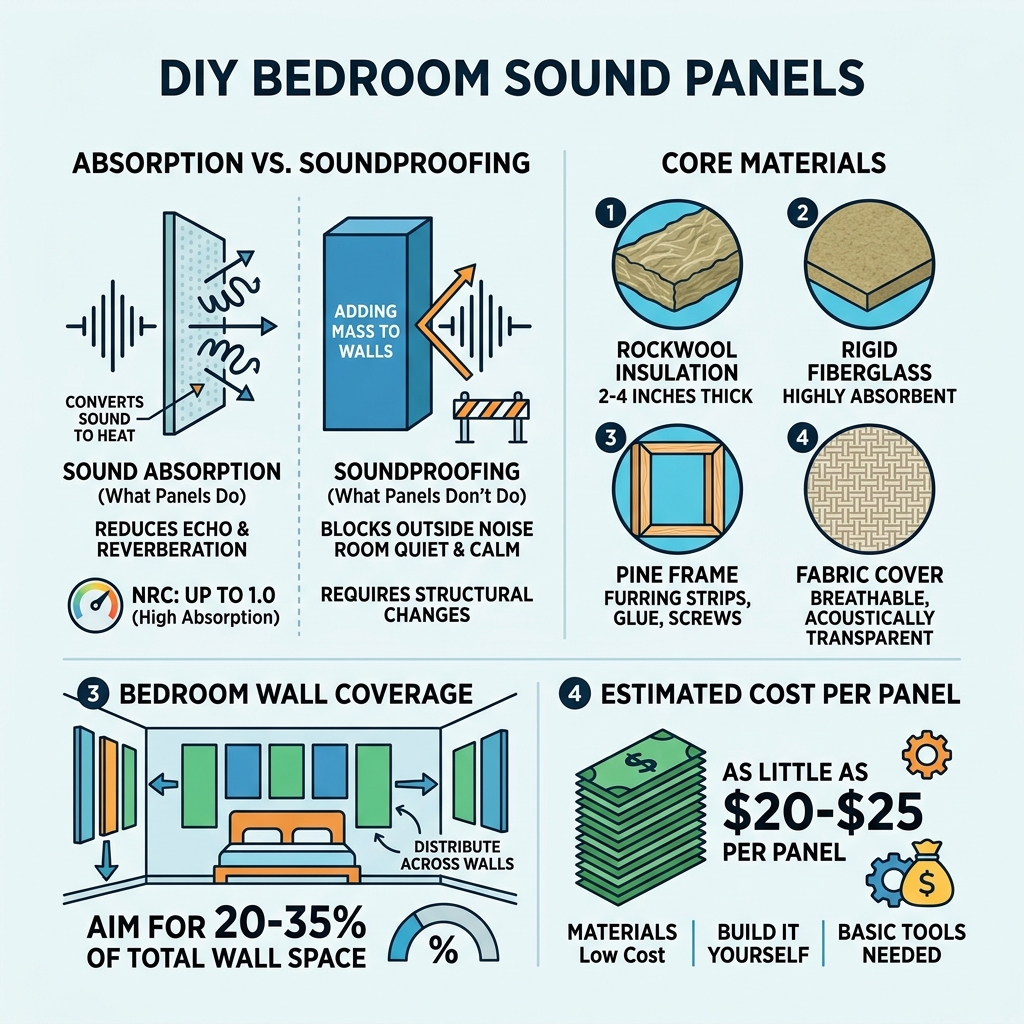
DIY bedroom sound panels are wall-mounted frames filled with sound-absorbing insulation and wrapped in breathable fabric — and you can build a set for as little as $20–$25 per panel.
Here’s what you need to know at a glance:
- They reduce echo and reverberation inside your room, making it quieter and calmer
- They do NOT block outside noise — that requires soundproofing (adding mass to walls)
- Core materials: Rockwool or rigid fiberglass insulation (2–4 inches thick)
- Frame: Pine furring strips, wood glue, and screws
- Cover: Any breathable, acoustically transparent fabric
- Coverage needed: Aim for 20–35% of your total wall space
- Mounting: Leave a 1.5–4 inch air gap from the wall for better low-frequency absorption
Hard bedroom walls, bare floors, and flat ceilings all reflect sound. Every noise bounces around the room — traffic outside, your TV, your partner’s voice, even your own breathing at 3am.
The result? A room that feels louder and more stressful than it should be. Poor sleep. Harder focus. Just a less comfortable space.
Most people assume fixing this costs hundreds of dollars or requires a contractor. It doesn’t.
A basic set of DIY panels — built in a weekend with tools you probably already own — can make a noticeable difference in how your bedroom sounds and feels. No advanced woodworking skills required.
Understanding Sound Absorption vs. Soundproofing in the Bedroom
Before we pick up a drill, we need to clear up a common misunderstanding. In acoustics, “soundproofing” and “sound absorption” are two very different animals. If your goal is to stop the sound of a leaf blower outside from entering your room, you are looking for soundproofing. If you want to stop the “ping-pong” effect of voices echoing off your bedroom walls, you need acoustic treatment (absorption).
Acoustic treatment involves using porous materials to catch sound waves. Instead of the sound bouncing off a hard drywall surface and returning to your ears, it enters the panel, where the friction of the fibers converts the sound energy into a tiny amount of heat. This is measured by NRC ratings (Noise Reduction Coefficient), where a rating of 1.0 means the material absorbs 100% of the sound hitting it.
Soundproofing, on the other hand, is about sound transmission. To stop sound from moving through a wall, you need mass (like heavy plasterboard or mass-loaded vinyl) and decoupling (breaking the physical connection between walls). While diy bedroom sound panels won’t stop your neighbor’s bass from coming through the wall, they will make the noise that does get in sound much “deader” and less intrusive.
For a deeper dive into these concepts, check out our DIY Soundproofing Acoustic Panels for Beginners.
| Feature | Sound Absorption (Panels) | Soundproofing (Construction) |
|---|---|---|
| Primary Goal | Reduce echo and improve internal sound quality | Block sound from entering or leaving a room |
| Materials | Rockwool, fiberglass, open-cell foam | Mass-loaded vinyl, double drywall, Green Glue |
| Installation | Hung on walls like picture frames | Built into the wall or floor structure |
| Best For | Better sleep, clearer TV audio, home studios | Noisy neighbors, traffic, loud instruments |
Essential Materials and Tools for DIY Bedroom Sound Panels
One of the best things about this project is the cost. While professional panels can retail for $50 to $100 each, we can build high-quality diy bedroom sound panels for approximately $20 to $28 per unit. This represents a 50% to 75% cost saving!
To get started, you’ll need to head to your local hardware store. Here is your shopping list for a standard 2′ x 4′ panel:
- Insulation Core: Rockwool Safe ‘n’ Sound or rigid fiberglass (Owens Corning 703).
- Frame Wood: 1×4 pine boards or furring strips. (Standard size is 1″x4″x8′).
- Backing Fabric: Landscaping fabric or weed barrier (keeps fibers contained).
- Facing Fabric: Breathable cotton, burlap, or dedicated acoustic fabric.
- Fasteners: 1.5-inch to 2-inch wood screws and heavy-duty staples.
- Mounting Hardware: D-rings, picture wire, or French cleats.
If you’re looking for a budget-friendly breakdown, we’ve previously explored Inexpensive DIY Wall Panels for Your Studio which uses similar materials.
Required Hand Tools
You don’t need a professional workshop to pull this off. Most of these tools are likely already in your garage:
- Miter saw or hand saw (to cut the frame to size)
- Power drill/driver (with a 1/8″ drill bit for pilot holes)
- Staple gun (manual or pneumatic)
- Utility knife (to trim insulation)
- Measuring tape and pencil
- Personal Protective Equipment (PPE): Gloves, a dust mask/respirator, and safety glasses.
Choosing the Best Core for DIY Bedroom Sound Panels
The “engine” of your panel is the insulation core. Not all insulation is created equal. For a bedroom, you want something dense but safe.
- Rockwool (Mineral Wool): This is the gold standard for DIYers. It’s fire-resistant, water-repellent, and incredibly effective at absorbing mid-to-low frequencies. A 3-inch thick slab of Rockwool Safe ‘n’ Sound is perfect for most bedroom applications.
- Rigid Fiberglass: Materials like Owens Corning 703 are industry favorites. They are lighter than Rockwool but slightly more expensive.
- Acoustic Foam: While easy to find, foam is often too thin to handle lower frequencies (like a partner’s snoring or low-frequency traffic rumble). If you do go this route, see our guide on Using Foam Panels Effectively.
For optimal performance, aim for a density of 6-8 pcf (pounds per cubic foot) and a thickness of at least 3-4 inches. This ensures you are catching more than just the high-pitched “hiss” in the room.
Step-by-Step Guide to Building Your Panels

Ready to build? Follow these steps to create a professional-looking panel that will last for years.
Step 1: Measure and Cut the Wood
For a standard 2’x4′ insulation slab, you’ll want your frame to fit snugly. Cut your 1×4 pine boards into:
- Two pieces at 48 inches (sides)
- Two pieces at 22.5 inches (top and bottom, assuming 3/4″ wood thickness)
Step 2: Assemble the Frame
Lay your pieces out to form a rectangle. Pro tip: Always drill pilot holes before driving screws. This prevents the pine from splitting. Apply a bead of wood glue to the joints for extra stability, then drive two screws into each corner. For more details on this phase, refer to our Step-by-Step Guide: DIY Acoustic Foam Panels.
Step 3: Add the Backing
Staple your landscaping fabric or weed barrier to one side of the frame. This acts as a “net” to hold the insulation in place and prevents any tiny fibers from escaping toward the wall. Pull it tight, but don’t worry about it being perfectly pretty—this side faces the wall!
Step 4: Insert the Insulation
Put on your gloves and mask. Lay the frame face down and press the Rockwool or fiberglass slab into the frame. It should be a “friction fit,” meaning it stays there on its own. If it feels loose, you can secure it with a few strips of wire or plastic strapping. You can find more construction tips in our Tutorial for Building Acoustic Panels.
Wrapping and Finishing Your DIY Bedroom Sound Panels
This is where your diy bedroom sound panels start to look like high-end decor.
The Exhale Test: Before you buy yards of fabric, perform the “exhale test.” Hold the fabric to your mouth and blow through it. If you feel the air pass through easily, it’s acoustically transparent. If the air is blocked, the sound waves will bounce off the fabric instead of entering the insulation. 100% cotton, burlap, and even some bedsheets work great.
The Wrapping Process:
- Lay your decorative fabric face down on a clean floor.
- Place the panel (insulation side down) on top of the fabric.
- Pull the fabric over one long side and staple it to the back of the wood frame.
- Move to the opposite side, pull it taut (but not so tight that you warp the frame), and staple.
- Gift-wrap the corners: Fold the fabric neatly like you’re wrapping a Christmas present. This is the difference between a “DIY project” and a “professional panel.”
- Trim any excess fabric with your utility knife or scissors.
If you’re looking for ways to save even more, check out these Alternatives to Expensive Soundproofing Foam.
Strategic Placement for Optimal Bedroom Quiet
Where you put your panels is just as important as how you build them. In a bedroom, we want to target the “first reflection points.”
The Mirror Trick: Sit on your bed where your head usually rests. Have a friend slide a mirror along the wall. Wherever you can see the reflection of your TV speakers or the door where noise enters, that is a first reflection point. This is where your first panel should go.
The 2-Inch Rule (Air Gaps): Research shows that mounting your panels 1.5 to 4 inches away from the wall significantly improves their ability to absorb lower frequencies. Why? Because the sound wave passes through the panel, hits the wall, and has to pass through the panel again on the way out. This “double-dip” effectively doubles the thickness of your treatment.
For more placement hacks, visit our guide on Bedroom Noise Reduction Techniques on a Budget.
Calculating Coverage for Your Bedroom
You don’t need to cover every square inch of your walls. In fact, doing so can make a room feel “dead” and unnatural, like being inside a cardboard box.
- The 20-35% Rule: Aim to cover 20% to 35% of the total wall surface area. For a typical 11′ x 13′ bedroom, 6 to 8 panels (2’x4′) are usually sufficient.
- Target the Corners: Low-frequency energy (bass) tends to build up in corners. If you have the space, placing a thicker panel (4 inches) across a corner creates a “bass trap.” This is particularly helpful if you have a neighbor with a loud home theater. Learn how to Create Your Own Bass Traps for Home Recording for maximum effectiveness.
Frequently Asked Questions about Bedroom Sound Panels
Can these panels block out a snoring partner or loud traffic?
The short answer is: they help, but they won’t solve it entirely. Snoring and traffic are often low-frequency sounds that travel through the structure of the house. DIY bedroom sound panels will absorb the “echo” of the snore, making it sound less sharp and annoying, but they won’t stop the vibration from reaching you. To truly block traffic, you would need to address the windows (thick glass or heavy curtains) and add mass to the walls.
How do I mount panels in a rental without damaging the walls?
We get it—security deposits are precious!
- Heavy-Duty Command Strips: If your panels are light (using foam or thin wood), these can work.
- French Cleats: These require screws but are very secure.
- Floor Stands: You can build simple “feet” for your panels so they lean against the wall like a floor mirror.
- Picture Wire: Treat them like heavy artwork. One or two small nail holes are usually easy to patch when you move out.
Is it safe to use Rockwool or fiberglass in a bedroom?
Yes, provided they are constructed correctly. The “danger” comes from inhaling the tiny mineral fibers. By using a dual-layer containment system (landscaping fabric on the inside and decorative fabric on the outside), you effectively seal the fibers within the frame. Once the panel is hung, it is inert and safe. Always wear a mask and gloves during the building phase to avoid skin irritation.
Conclusion
Building your own diy bedroom sound panels is one of the most rewarding home improvement projects you can tackle. For less than the cost of a new set of sheets, you can transform your bedroom into a sanctuary of quiet and calm. Not only will you sleep better, but your room will look more polished and intentional.
At TechAvanco, we believe that home comfort shouldn’t come with a premium price tag. By using these practical, cost-effective techniques, you can take control of your environment and create a space that truly supports your productivity and rest.
Ready to dive deeper into making your home whisper-quiet? Check out More info about acoustic tips for our latest guides and hacks. Happy building!
