
Why Accent Wall MDF Boards Are the Smartest DIY Upgrade You Can Make
Accent wall MDF boards are one of the most affordable ways to transform a plain room into something that looks professionally designed. Whether you want a grid wall, slat wall, or board and batten style, MDF makes it achievable on a tight budget — often in a single weekend.
Here’s what you need to know at a glance:
- What they are: MDF (Medium Density Fiberboard) boards cut into strips and mounted on a wall in decorative patterns
- Cost: A DIY project typically requires around 14 boards for a standard 160-inch wide wall, with pre-cut kits starting around $240
- Time: Most beginner projects take just 2-4 hours to install
- Best for: Living rooms, bedrooms, home offices, and vacation rentals
- Tools needed: Brad nailer, level, measuring tape, saw (or ask your hardware store to cut for you), construction adhesive, caulk, and paint
- Key tip: Paint your boards before mounting them for easier, more even coverage
MDF is smooth, paintable, and won’t warp the way solid wood can. That makes it ideal for wall projects where a clean, consistent finish matters — especially when you’re working with a limited budget and want results that look expensive.
A lot of homeowners are surprised by just how much impact a single accent wall can have. It changes the entire feel of a room, makes decor pop, and even creates a great backdrop for video calls or photos. And because MDF is so workable, even first-time DIYers can pull off a professional-looking result.
Below, this guide walks you through everything — from choosing a design to the final coat of paint.
Why Choose Accent Wall MDF Boards for Your Home?
When we think about wall paneling, we often picture the heavy, dark oak of a library or the dated veneer of a 1970s basement. Modern accent wall mdf boards are a completely different animal. MDF, or Medium Density Fiberboard, is an engineered wood product made by breaking down hardwood or softwood residuals into wood fibers, combining them with wax and a resin binder, and forming them into panels by applying high temperature and pressure.
So, why do we recommend MDF over traditional solid wood?
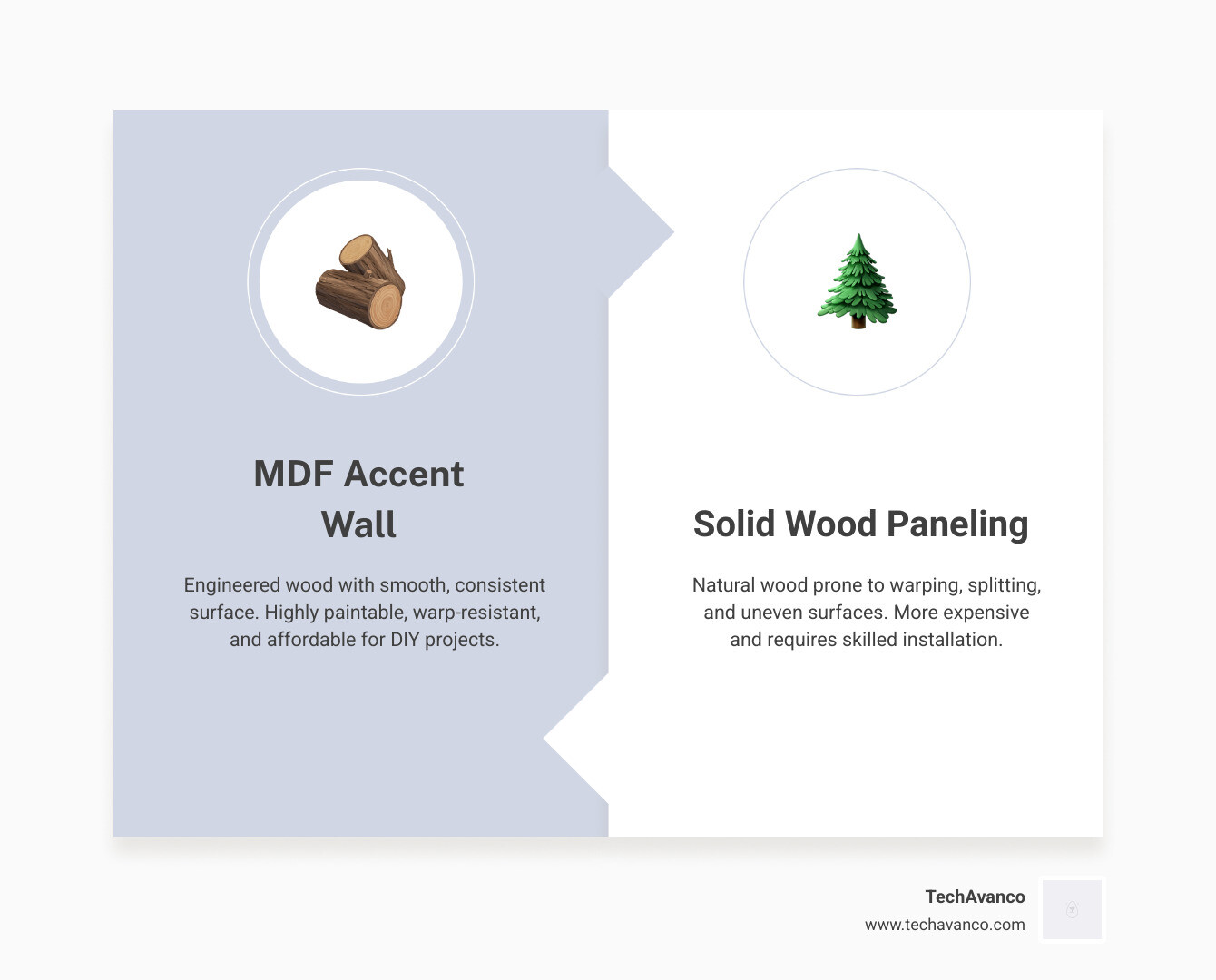
- Surface Consistency: Unlike natural timber, MDF has no knots, grain patterns, or “wild” spots. This means when you paint it, the finish is as smooth as glass.
- Warp Resistance: Solid wood is a living material that expands and contracts with humidity. MDF is much more stable, making it less likely to cup or bow once it’s on your wall.
- Cost-Effectiveness: You can often achieve the same look as high-end custom millwork for a fraction of the price. For example, a standard 48-in x 96-in MDF panel can cover 32 square feet for significantly less than solid pine or oak.
- Workability: It’s incredibly easy to cut and sand. Many local hardware stores like Home Depot or Lowe’s will even rip large sheets into strips for you, saving you the hassle of owning a table saw.
If you are curious about how this fits into a broader DIY strategy, check out our wood-you-believe-it-a-simple-diy-accent-wall-guide for more inspiration. For those looking for specific high-quality materials, MDF Ceiling & Wall Planks offer precise tolerances that make installation a breeze.
MDF vs. Traditional Wood Paneling
| Feature | MDF Boards | Traditional Solid Wood |
|---|---|---|
| Surface | Perfectly smooth, no knots | Natural grain, potential knots |
| Stability | High resistance to warping | Prone to expansion/contraction |
| Paintability | Excellent (requires priming) | Good, but grain may show through |
| Cost | Budget-friendly | Mid-to-high range |
| Sustainability | Made from recycled fibers | Depends on sourcing |
Popular Designs for MDF Accent Walls
The beauty of accent wall mdf boards lies in their versatility. You aren’t stuck with one look; you can create anything from a traditional Victorian feel to a ultra-modern geometric masterpiece. If you’re looking for studio-wall-treatment-ideas, MDF is often the first material we suggest.
Here are the most popular styles we see today:
- The Grid Wall: This involves creating a series of squares or rectangles across the entire wall. It’s a bold statement that works perfectly in home offices or behind a bed.
- Geometric Layouts: If you’re feeling artistic, you can arrange MDF strips in triangles, chevrons, or abstract patterns.
- Shiplap and Tongue and Groove: For a rustic or coastal vibe, horizontal planks are the way to go. You can find Tongue and Groove MDF Panels that mimic the look of traditional siding but are much easier to install indoors.
- Beaded Wainscoting: Often used on the bottom third of a wall, this provides a classic, timeless look.
Creating a Modern Slat Wall with Accent Wall MDF Boards
Slat walls are currently exploding in popularity. They offer a textured, linear look that can make a ceiling feel higher or a room feel wider. Using 1×3 MDF boards (which are actually about 2.5 inches wide) is a great “chunky” alternative to the skinnier 1x2s often seen in older designs.
When building a slat wall, spacing is everything. A common approach is to use 3-inch boards with 2-inch spacing on each side. For rooms with higher humidity, such as kitchens or utility rooms, we recommend using Legacy SlatWall MDF Panel options made from Hidrofugo. This is a high-density, moisture-resistant MDF that won’t swell when things get steamy.
If you’re setting up a creative space, these slats can also help with sound diffusion. We’ve covered this in our guide on inexpensive-diy-wall-panels-for-your-studio.
Classic Board and Batten Styles
Board and batten is the “little black dress” of home decor—it never goes out of style. Traditionally, this involved a flat “board” on the wall with vertical “battens” covering the seams. Today, most DIYers simply use the existing drywall as the “board” and install MDF strips directly over it to create the look.
For a bedroom update, we love a 4-foot tall board and batten wall topped with a small ledge. It adds architectural interest without overwhelming the space. You can find a wide variety of MDF Wall Panels in Decorative & Paintable Styles that come pre-primed, saving you a massive amount of prep time.
Step-by-Step Guide to Installing Your MDF Accent Wall
Ready to get your hands dirty? Don’t worry; this is a beginner-friendly project. Even if you’ve never used a power tool in your life, you can handle this. If you can use a tape measure and a level, you’re halfway there.
Before you start, gather your supplies:
- Accent wall mdf boards (1×3 or 1×4 are standard)
- Brad nailer (cordless is easiest)
- Construction adhesive (like Liquid Nails)
- Wood filler or spackle
- Caulk and a caulking gun
- Fine-toothed saw (or have them cut at the store)
- Level and measuring tape
If the thought of measuring and cutting makes you break out in a cold sweat, you can purchase a DIY MDF accent wall panels kit that comes pre-cut and ready to install. For more technical details on mounting panels, our step-by-step-guide-diy-acoustic-foam-panels covers similar adhesive and leveling techniques.
Planning and Measuring for Accent Wall MDF Boards
The “measure twice, cut once” rule is your best friend here. We always suggest drawing your wall to scale on graph paper first. This helps you visualize where outlets are and how many “columns” and “rows” will look best.
The Spacing Math:
- Measure the total width of your wall in inches.
- Decide how many vertical boards you want.
- Subtract the total width of all boards from the wall width.
- Divide that number by the number of spaces between the boards.
For example, if you have a 160-inch wall and want 5 columns (which requires 6 boards), and your boards are 3.5 inches wide:
- Total board width = 6 x 3.5 = 21 inches.
- Remaining space = 160 – 21 = 139 inches.
- Spacing = 139 / 5 = 27.8 inches between each board.
For more advanced layout planning, especially if you’re dealing with acoustics, see our studio-wall-treatment-ideas-2 guide.
Installation and Professional Finishing
Once your plan is set, it’s time to mount.
- Prep the Wall: Remove any existing baseboards if you want the MDF to sit flush against the floor. Paint the wall the desired color first; it’s much easier than painting inside the gaps later!
- Install Verticals: Start from the center of the wall and work your way out. This ensures that if your wall isn’t perfectly square (and they never are), the unevenness is hidden in the corners. Apply a bead of Liquid Nails to the back, press it to the wall, check it with your level, and fire a few brad nails every 10-12 inches.
- Add Horizontals: If you’re doing a grid, measure the distance between your installed verticals for each horizontal piece. Walls can vary, so don’t assume every horizontal cut will be the same!
- The “Pro” Finish: This is the most important step. Fill every nail hole with wood filler and caulk every single seam where the MDF meets the wall. This makes the boards look like they are part of the wall rather than just stuck on top.
- Sand and Paint: Once the filler is dry, sand it smooth. Apply your final coats of paint. We recommend a high-quality water-based paint in an eggshell or satin finish for the best look.
For a deep dive into professional-grade installation, check out the-ultimate-guide-to-diy-acoustic-panel-installation-and-crafting.
Frequently Asked Questions about MDF Accent Walls
Can I use accent wall MDF boards in high-humidity areas like bathrooms?
Yes, but you must choose the right type. Standard MDF acts like a sponge when it gets wet. For bathrooms or kitchens, look for “moisture-resistant” MDF, often referred to as Hidrofugo. These boards usually have a green core. Even with moisture-resistant boards, you must ensure all edges are sealed with primer and paint, and the room has adequate ventilation.
Should I paint the MDF boards before or after installation?
We highly recommend painting the boards (and the wall) before you nail them up. It is much faster to use a roller on a flat board on a pair of sawhorses than it is to use a brush in tight corners once it’s on the wall. You will still need to do some touch-up painting after you’ve filled the nail holes and caulked the seams, but 90% of the work will be done.
How do I calculate the number of boards needed for a grid wall?
As a rule of thumb, for a standard 160-inch wide by 96-inch high wall, you will likely need about 14 boards (assuming 3.5-inch width). Always buy 10-15% more than you think you need to account for “oops” cuts. If you’re using 8-foot boards, you can often cut them in half for 4-foot tall board and batten projects, maximizing your material.
Conclusion
At TechAvanco, we believe that enhancing your home shouldn’t require a second mortgage. Using accent wall mdf boards is a prime example of a high-impact, low-cost project that improves both your home’s aesthetics and your personal comfort. Whether you’re creating a cozy bedroom retreat or a professional-looking home office, MDF provides the foundation for a stunning transformation.
If you enjoyed this project, you might also be interested in our tutorial for building acoustic panels to further improve your space’s productivity and sound quality.
Ready to take the next step in your home improvement journey? Explore more DIY soundproofing and wall treatment guides on our site and start building the home you’ve always wanted. Happy DIYing!
