
Quiet Please! Our Top Picks for Noise Reduction Between Rooms
Why Noise Between Rooms Is Harder to Stop Than You Think
Noise reduction between rooms is something millions of homeowners and renters struggle with every day. Whether it’s a TV blaring through a shared wall, footsteps thumping overhead, or a partner’s late-night phone calls bleeding into the bedroom, unwanted sound is a real problem for sleep, focus, and comfort.
The good news? You don’t need a $200,000 renovation to make a meaningful difference.
Here are the most effective ways to reduce noise between rooms, from quick DIY fixes to more involved upgrades:
| Method | Best For | Effort Level | Approx. Cost |
|---|---|---|---|
| Weatherstripping & door sweeps | Doors leaking sound | Low | $ |
| Acoustic curtains (12-18 oz fabric) | Windows, shared walls | Low | $ |
| High-density rugs + felt pads | Impact noise, floors | Low | $$ |
| Acoustical caulk & gap sealant | Outlets, vents, cracks | Low | $ |
| Mass loaded vinyl (MLV) | Walls, ceilings | Medium | $$ |
| Green Glue + extra drywall layer | Existing walls | Medium | $$ |
| Resilient channels + insulation | Walls, ceilings | High | $$$ |
| Solid-core door replacement | Doors | Medium | $$$ |
Sound sneaks through your home in two main ways: airborne sound (voices, music, TV) travels through the air and vibrates surfaces it hits, while structural sound (footsteps, slamming doors) travels as vibration directly through the building materials themselves. Both require different solutions, and most rooms have a combination of both problems.
One key insight that often surprises people: a gap covering just 1% of a wall or door can let through up to 30% of sound. A 5% gap leaks a staggering 90%. This means sealing is often more important than adding mass.
This guide covers the best products and strategies to tackle both types of noise — without necessarily tearing down walls.

The Science of Sound: Airborne vs. Structural Noise
To master noise reduction between rooms, we first have to understand the enemy. In acoustics, sound isn’t just “noise”—it’s energy that moves in two distinct ways.
Airborne Sound
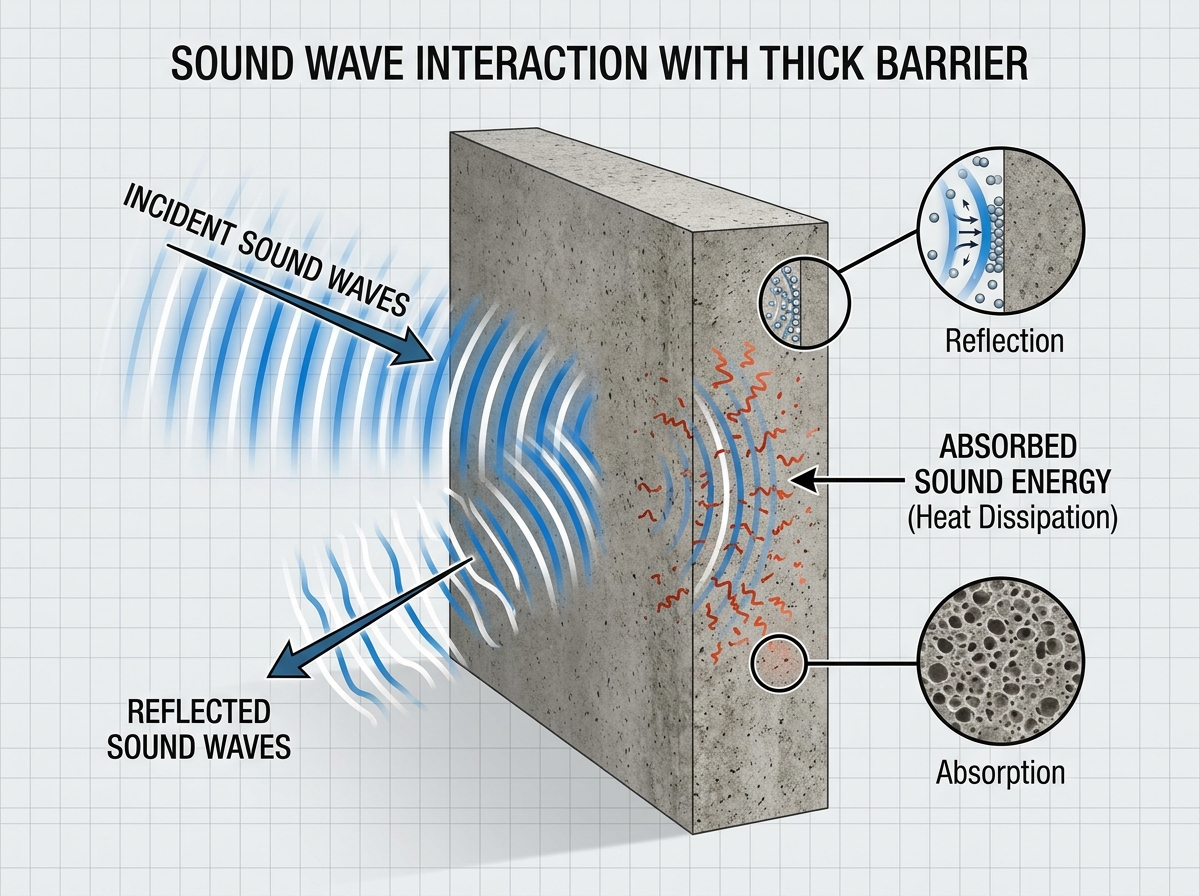
This is the sound we are most familiar with. It travels through the air as pressure waves. Think of your neighbor’s late-night Netflix binge, a crying baby, or a dog barking in the next room. When these waves hit a wall, they vibrate the structure, which then vibrates the air on the other side. To stop this, we need mass and density. A standard glass window pane has a Sound Transmission Class (STC) rating of about 25, meaning it blocks very little. In contrast, an 8-inch concrete wall boasts an STC of 72, effectively silencing almost everything.
Structural Sound (Impact Noise)
This is the “thud-thud-thud” of footsteps from the floor above or the vibration of a washing machine. This sound travels through the physical framework of the building—the studs, joists, and floorboards. Because the materials are physically connected, the vibration moves like a train on a track. To fix this, we use the mass-spring principle and decoupling. Decoupling involves breaking the direct physical connection between two surfaces so vibrations can’t pass through.
Key Metrics: STC vs. NRC
When shopping for products, you’ll see two main ratings:
- STC (Sound Transmission Class): Measures how well a partition (like a wall or door) blocks sound from passing through it. Higher is better.
- NRC (Noise Reduction Coefficient): Measures how much sound a material absorbs inside a room to stop echoes. It ranges from 0 (perfect reflection) to 1 (perfect absorption).
Planning for these factors during the blueprint phase of construction is the most cost-efficient way to achieve peace. However, for most of us living in existing homes, we have to look at retrofitting. Check out our guide on building interior sound-isolating walls for a deep dive into professional-grade construction.
Top Strategies for Noise Reduction Between Rooms
If you are dealing with a “noisy” wall, you have several paths forward. The goal is usually to increase the STC rating of the barrier.
The Power of Damping and Mass
One of the most effective professional strategies is adding a second layer of drywall with a damping compound like Green Glue sandwiched in between. This compound converts sound energy into heat, significantly reducing the “drum” effect of hollow walls. If you are starting from scratch or willing to open up the walls, adding mineral wool insulation is a must. Unlike standard pink fiberglass, mineral wool is incredibly dense and acts as a heavy muffler for sound.
Decoupling with Resilient Channels
For structural noise, we use resilient channels. These are thin metal rails that you attach to the studs before hanging drywall. By doing this, the drywall “floats” and isn’t directly nailed to the wood frame. This break in the connection stops vibrations in their tracks.
Managing Impact Noise on Floors
If the noise is coming from above, floors need attention. Joist tape can be applied to the tops of floor joists to prevent squeaks and dampen vibrations. For a finished room, adding a high-quality underlayment beneath hardwood or laminate is essential. Learn more about optimizing your environment in our articles on how to reduce noise in a small studio and advanced studio noise reduction.
Professional Materials for Noise Reduction Between Rooms
When you’re ready to get serious, certain specialized materials offer the best “bang for your buck” in terms of decibel reduction.
- Noise-Reducing Drywall: Products like SilentFX QuickCut drywall are engineered with a viscoelastic polymer layer between two gypsum cores. When properly installed, this drywall can achieve an STC of 50 or higher, which is the point where loud speech becomes virtually inaudible.
- Mass Loaded Vinyl (MLV): Often sold under names like SheetBlok, this material is only 1/8″ thick but is more effective than solid lead at stopping sound. It’s incredibly heavy and flexible, making it perfect for wrapping pipes or lining walls.
- Acoustical Sealants: Never underestimate a product like StopGap. When applied to the perimeters and seams of a wall, it can help maintain an STC of 53.
- The Airspace Rule: For those building new walls, an airspace of 1″ minimum (and 2″ ideally) between wall frames is advised for sound isolation. Anything beyond 2″ offers diminishing returns.
While these materials are professional-grade, the estimated material cost for building sound-isolating walls is roughly $10 per square foot. For more tips, see our post on affordable home studio soundproofing.
DIY Noise Reduction Between Rooms for Renters
We know that not everyone can tear down their walls. If you’re renting or on a tight budget, you can still make a massive dent in the noise levels using “soft” solutions.
Acoustic Curtains and Drapes Standard curtains won’t do much. For effective noise reduction between rooms, look for drapes made of heavy material, specifically 12 oz to 18 oz/yd. To get the best results, ensure the curtains have “100% fullness” (meaning they are twice as wide as the window) and mount the rod 3-4 inches off the wall to create an air pocket.
High-Density Rugs and Pads A common myth is that a fluffy rug will stop noise. In reality, a higher rug pile height only accounts for about a 2% reduction in sound. The real magic happens in the rug pad. Use a thick felt or acoustic foam underlayment. Felt is particularly good at absorbing the frequencies of human speech.
Strategic Furniture Placement The “maximalist” approach to decor is actually great for acoustics. Pushing a large, heavy bookshelf filled with books against a shared wall creates a massive barrier. Hardwood shelves are better for blocking loud noise, while softer woods help absorb ambient room echoes.
Sound Masking (White and Brown Noise) Sometimes, you can’t block the sound, so you have to mask it.
- White Noise: Best for general sounds like street noise or distant conversations.
- Brown Noise: Better for low-frequency rumbles, like a snoring neighbor or a heavy-footed upstairs tenant.
For more renter-friendly hacks, check out our soundproofing tricks for small apartments and budget bedroom techniques.
Sealing the Gaps: Doors, Windows, and Outlets
You could have a foot-thick concrete wall, but if there’s a half-inch gap under the door, the sound will pour through like water. Remember our statistic: a gap of just 5% in a barrier leaks 90% of the sound.
The Door Problem
Most interior doors are “hollow core,” which are essentially two thin sheets of veneer with air (or cardboard) in the middle. They act like a drum. Replacing these with solid-core doors is one of the single best upgrades you can make.
- Weatherstripping: Apply adhesive rubber seals around the door frame.
- Door Sweeps: Install a heavy-duty sweep or an automatic door bottom that drops down when the door closes to seal the gap at the floor.
Windows and Outlets
Windows are often the weakest link. If you can’t replace them, consider Indow Inserts or secondary window kits. Even smaller culprits like electrical outlets can be a problem. Sound travels through the holes in the wall where the boxes are mounted. Using acoustical putty pads to wrap the back of the electrical boxes can stop this “flanking” noise.
For a detailed breakdown of door-specific fixes, visit soundproofing doors without overspending and our guide on window soundproofing solutions.
Frequently Asked Questions about Soundproofing
What is the difference between STC and NRC ratings?
STC (Sound Transmission Class) tells you how much sound is blocked from traveling through a wall or door to the next room. NRC (Noise Reduction Coefficient) tells you how much sound is absorbed within the room to reduce echoes. For noise reduction between rooms, you generally want to focus on products with a high STC rating.
Why is sealing small gaps so important for noise reduction?
Sound waves behave like air and water; they follow the path of least resistance. A tiny 1% gap in a wall—like a crack under a door or a gap around a vent—can allow 30% of the total sound energy to pass through. If you don’t seal the gaps, adding mass to the walls is often a waste of money.
Is it better to soundproof during construction or as a renovation?
It is significantly more effective and cost-efficient to implement soundproofing during the blueprint phase. You can choose superior materials like mineral wool and specialized drywall for a fraction of the cost it takes to retroactively strip a room to the studs and rebuild it. However, as we’ve shown, many “renovation-lite” options like Green Glue or heavy drapes can still provide excellent results.
Conclusion
At TechAvanco, we believe that a quiet home is a productive and happy home. Achieving effective noise reduction between rooms doesn’t have to be an all-or-nothing project. By starting with the “low-hanging fruit”—like sealing gaps with acoustical caulk, adding heavy drapes, and using high-density rug pads—you can reclaim your peace of mind without breaking the bank.
Whether you’re a renter looking for a quick fix or a homeowner planning a major upgrade, our goal is to provide the practical, cost-effective tips you need to enhance your lifestyle. Ready for more? Explore our full library of DIY soundproofing tips and guides to turn your home into the oasis you deserve.
