
How Acoustic Bedroom Door Seals Transform Your Sleep
When we talk about soundproofing, we often focus on thick walls or heavy curtains, but the door is almost always the weakest link in any room. In fact, research shows that a tiny 1% opening around a door can allow up to 50% of the sound energy to leak through. If you have a 1/8-inch gap around all four sides of your door, you could reduce the effectiveness of a high-quality door by more than half. This is often compared to the “12-inch hole analogy”—a small gap around the perimeter of a door is acoustically equivalent to having a massive hole cut right through the center of the wood.
Acoustic bedroom door seals work by eliminating these “sound leaks.” By creating an airtight perimeter, they force sound waves to try and pass through the actual mass of the door rather than simply flowing around it. This is where the Sound Transmission Class (STC) rating comes into play. A standard solid-core door might have an STC of around 22 on its own, but once you add professional-grade acoustic bedroom door seals, that rating can jump by 20 points or more. This significant increase means that loud speech, which was once intelligible, becomes a faint, unrecognizable murmur.
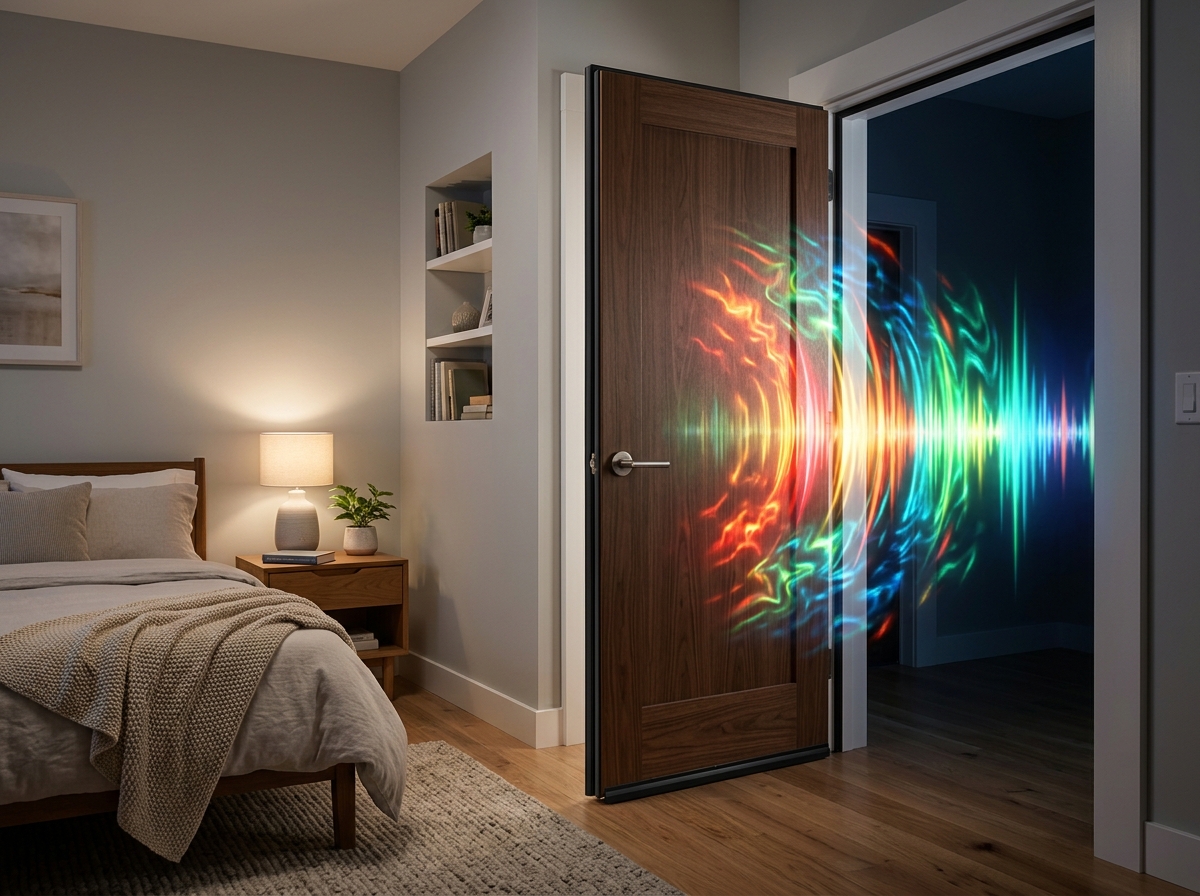
This transformation is vital for two reasons: sleep quality and privacy. For those of us on a budget, focusing on bedroom-noise-reduction-techniques-on-a-budget means prioritizing the gaps first. By addressing airborne noise—the sounds that travel through the air like voices, TV audio, and barking dogs—you create a sanctuary.
Furthermore, these seals help with “damping,” which reduces the vibration of the door itself. When sound hits a door, the door can act like a drum skin, vibrating and passing that noise into your room. High-quality seals, especially those made of dense materials like neoprene, help “grip” the door and dampen those vibrations, effectively turning a resonant surface into a deadened one.
Types of Acoustic Door Seals for Every Budget
Not all seals are created equal. Depending on whether you are renting a small apartment or upgrading a forever home, your needs will vary.
| Seal Type | Material | Best For | Noise Reduction |
|---|---|---|---|
| Gasket Tape | Foam/Rubber | Renters, light noise | Moderate |
| Door Sweeps | Silicone/Vinyl | Bottom gaps, DIYers | Good |
| Automatic Bottoms | Neoprene/Aluminum | Serious studios, loud homes | Excellent |
| Jamb Seals | Anodized Aluminum | Permanent installs | Excellent |
When soundproofing-doors-without-overspending, it is helpful to understand the materials. Silicone is flexible and great for uneven gaps, while neoprene is the industry standard for high-density sound blocking. Neoprene is particularly valued for its durability and resistance to “compression set,” meaning it won’t stay flattened after the door has been closed for long periods. For more ideas on how to mix and match these, check out our easy-diy-soundproofing-hacks.
Adhesive Gasket Tape and Foam Seals
This is the “entry-level” of acoustic bedroom door seals. These are usually peel-and-stick rolls of closed-cell foam or rubber. The goal here is compression; when the door closes, it should squeeze the foam against the stop, creating a seal.
While these are budget-friendly and great for homemade-methods-for-soundproofing, they do have a shorter lifespan. Over time, the foam can lose its “spring” and stop sealing effectively. However, for a quick fix against hallway light and muffled conversations, a roll of high-quality weatherstripping is a fantastic starting point. It is an essential first step for anyone looking to improve their acoustic environment without a major renovation.
Professional-Grade Acoustic Bedroom Door Seals
If you want to stop hearing the vacuum cleaner in the hallway entirely, you need to look at professional kits. These typically include three adjustable jamb seals (for the top and sides) and an automatic door bottom. These systems are designed to create a true airtight seal that mimics the performance of expensive laboratory-grade acoustic doors.
These kits often use anodized aluminum housings that hold heavy-duty neoprene gaskets. The “adjustable” part is key—as your house shifts or the door settles, you can turn a few screws to push the seal tighter against the door. A complete kit with an acoustic threshold ensures that even the floor-level gap is completely airtight. These systems are often spring-loaded, meaning the seal only drops down when the door is fully closed, preventing wear and tear on your carpets and ensuring the door remains easy to open and close.
Measuring and Installing Your Acoustic Bedroom Door Seals
Precision is the name of the game. Before you click “buy” on a kit, you need to grab a tape measure. We recommend measuring the width of the door frame at the top and the height from the floor to the top of the frame. Even a quarter-inch discrepancy can lead to gaps that compromise the entire soundproofing project.

Most professional kits allow for some “field cutting,” meaning you can trim the aluminum and neoprene to fit your specific door. However, there are limits—usually, you can’t trim more than an inch or two off an automatic door bottom without hitting the internal spring mechanism. When cutting, use a fine-toothed hacksaw for the metal and a sharp utility knife for the rubber. For a deeper dive into the tools you might need, see our guide-to-cheap-studio-soundproofing.
Step-by-Step Installation for Bedroom Privacy
- Clean the Surface: Use rubbing alcohol to remove dust and oils from the door jamb. This is crucial for adhesive seals to bond permanently.
- Dry Fit: Hold your seals up to the door to ensure they don’t interfere with the latch or hinges. Mark your drill points with a pencil.
- Install the Jambs: Start with the top piece, then the sides. If using screw-in seals, drill pilot holes first to avoid splitting the wood of your door frame.
- The Bottom Seal: If using a surface-mounted sweep, ensure it just touches the floor (or threshold) when closed. It should not drag heavily, as this will damage the seal over time.
- Test the Latch: Sometimes a good seal makes the door harder to close. You may need to adjust your strike plate slightly to accommodate the new thickness and ensure the door latches securely.
If you are a renter, stick to surface-mounted options. These are easier to remove later with a little heat from a hairdryer to break down the adhesive without damaging the paint. For more renter-specific advice, check out soundproofing-tricks-for-small-apartments.
Maximizing Performance: Solid-Core vs. Hollow-Core Doors
We have to be honest with you: even the best acoustic bedroom door seals can only do so much if your door is a “hollow-core” door. Most modern interior doors are essentially two thin layers of wood with a cardboard honeycomb inside. They are light, cheap, and unfortunately, they act like a drum, vibrating with every sound.
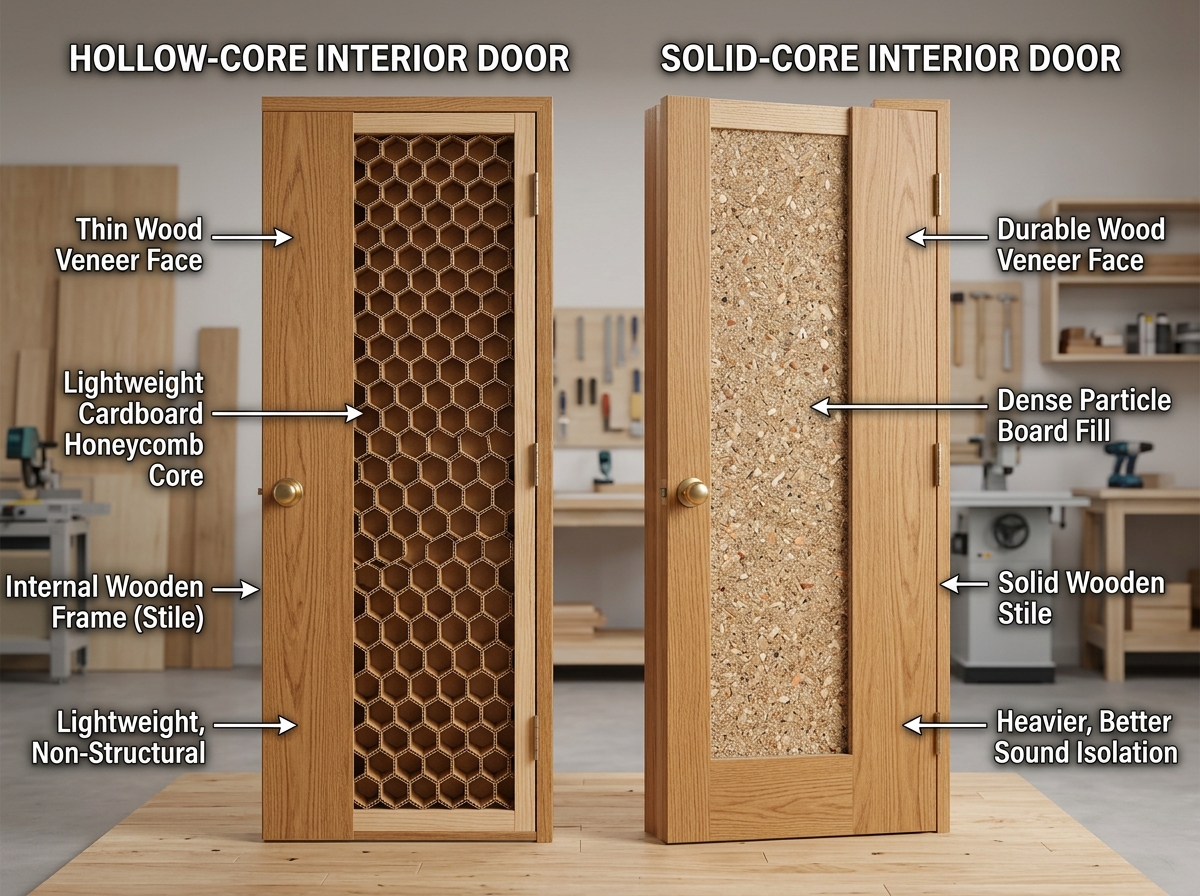
To get the most out of your seals, you ideally want a solid-core door. A solid wood or particle-board door has the mass required to actually block sound. If you’re stuck with a hollow door and can’t replace it, you might consider adding a “door liner” or a layer of mass-loaded vinyl (MLV) to the back of the door. For more on this, read our tips on ditch-the-noise-affordable-ways-to-soundproof-your-home-studio.
Enhancing Acoustic Bedroom Door Seals with Liners
If seals alone aren’t enough, you can “bulk up” your door. Sound blankets or acoustic door liners can be hung over the door to add mass and absorption. Some people even use damping compounds between two layers of wood if they are feeling particularly DIY-heavy.
Combining acoustic bedroom door seals with these liners creates a “decoupled” system that handles both airborne noise and vibrations. For those who want to go all out, you can even find kits that include window inserts if your bedroom door has a decorative glass pane. Check out easy-diy-soundproofing-hacks-2 for more creative layering ideas.
Frequently Asked Questions about Bedroom Soundproofing
Can I use acoustic seals on a hollow-core door?
Yes, you can, and it will help. Sealing the air gaps is always the first step. However, you will still hear noise coming directly through the door itself. Think of it like fixing a leak in a bucket that has very thin walls—the water stops pouring out the hole, but the walls might still sweat. For the best results, you should eventually look into adding mass to the door surface.
How many STC points do door seals actually add?
On a solid-core door, a high-quality kit can add up to 20 STC points. To put that in perspective, a 10-point increase is often perceived by the human ear as a 50% reduction in noise. This means a properly sealed door can make a loud television in the next room sound like a distant whisper.
Do I need a threshold for the bottom seal to be effective?
While not strictly required, a flat, smooth threshold provides a much better mating surface for the seal than carpet does. If you have thick carpet, the seal might not “bite” well enough to block all the air. A smooth metal or wood threshold allows the neoprene to compress fully, creating the necessary airtight barrier.
How long do professional acoustic seals last?
Unlike standard foam weatherstripping, professional-grade neoprene and silicone seals are built for longevity. You can typically expect a high-quality aluminum-housed seal to last 15 years or more with minimal maintenance. Occasionally cleaning the gaskets with a damp cloth to remove dust will ensure they continue to provide a perfect seal.
Conclusion
At TechAvanco, we believe that your home should be your fortress of solitude. You don’t need a thousand-dollar “studio door” to get a good night’s sleep. By starting with high-quality acoustic bedroom door seals, you address the most significant weakness in your room’s defenses. Whether you choose a simple foam tape or a professional-grade adjustable kit, the goal is the same: stop the air, stop the noise.
For more practical ways to improve your living space without breaking the bank, dive into our category/diy-soundproofing or explore our full library of home improvement guides. Sleep tight!
