
The Lazy Person’s Guide to a Quiet Bedroom
Your Bedroom Should Be Quiet — Here’s Why It Probably Isn’t
Practical soundproof bedroom hacks are simpler than most people think — and you don’t need to tear down walls or spend a fortune to get real results.
Here’s a quick overview of the most effective methods:
| Hack | Best For | Effort Level |
|---|---|---|
| Seal gaps around doors and windows | Stopping sound leakage | Low |
| Add a thick rug with a felt pad | Absorbing floor noise | Low |
| Hang heavy curtains (12-18 oz fabric) | Blocking street noise | Low |
| Place bookshelves against shared walls | Adding mass to thin walls | Low |
| Use a door sweep | Sealing the gap under your door | Low |
| Install acoustic panels or wall tapestries | Absorbing echo and neighbor noise | Medium |
| Use a white or brown noise machine | Masking leftover noise | Low |
Noise doesn’t just annoy you — it actively harms your sleep. The World Health Organization recommends that nighttime bedroom noise stay below 30 decibels, which is roughly the level of a whisper. Most of us are nowhere near that.
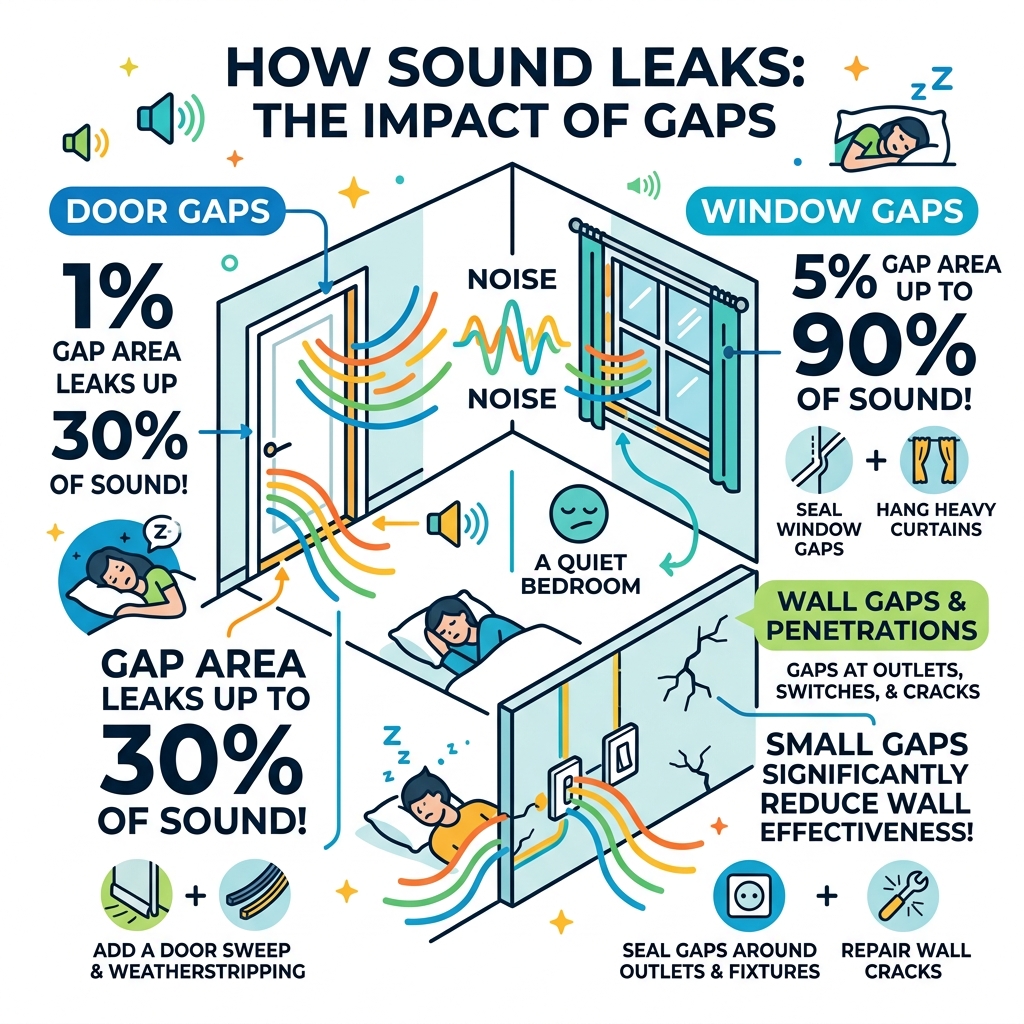
Traffic, neighbors, thin walls, hollow doors — modern homes are practically designed to let sound travel freely. Light construction materials like drywall and hollow-core doors do very little to stop noise in its tracks. And here’s the part that surprises most people: a gap covering just 1% of a wall or door can leak up to 30% of sound through it. A 5% gap lets through 90%.
That means even small fixes — sealing a door gap, adding a rug, hanging thicker curtains — can make a real difference.
This guide covers practical, affordable hacks that actually work, whether you’re a renter who can’t drill holes or a homeowner ready to go a step further.
Quick Fixes: Practical Soundproof Bedroom Hacks for Renters
If you are renting, you probably don’t have the luxury of ripping out drywall to install rockwool insulation. You need solutions that are “non-invasive”—meaning they won’t cost you your security deposit. The secret to soundproofing thin walls without construction lies in two principles: adding mass and improving absorption.

One of the most effective practical soundproof bedroom hacks is strategic furniture placement. If you can hear your neighbor’s late-night TV through a shared wall, don’t just suffer in silence. Move your heaviest furniture against that wall. A large dresser, a heavy wardrobe, or better yet, a floor-to-ceiling bookshelf acts as a shield.
Books are incredibly dense. When you fill a bookshelf with a variety of hardback and paperback books, you are essentially building a second wall. This adds “mass,” which makes it much harder for sound vibrations to pass through. For the best results, ensure the bookshelf covers as much of the wall surface as possible.
For those dealing with particularly loud environments, soundproofing tricks for small apartments often involve temporary wall coverings. Mass-loaded vinyl (MLV) is a heavy, flexible material that you can hang like a curtain or tack behind a tapestry. It’s thin but extremely dense, making it a powerhouse for blocking airborne noise like conversations or music.
Why does this matter? According to research on noise and sleep disruption, even low-level environmental noise can fragment sleep cycles and increase cortisol levels. By simply rearranging your room, you’re not just decorating; you’re protecting your health.
Sealing the Gaps: Practical Soundproof Bedroom Hacks for Doors
The door is often the weakest link in your bedroom’s defenses. Most modern interior doors are “hollow-core,” meaning they are basically two thin sheets of veneer with air or cardboard honeycombs inside. They act more like a drum than a barrier.
To fix this without replacing the door, we need to focus on the gaps. 1% gap rule? Most of that leakage happens at the bottom of the door. Installing a heavy-duty door sweep is one of the best bedroom noise reduction techniques on a budget. Look for silicone or rubber sweeps that create a tight seal against the floor.
For the sides and top of the door frame, use adhesive weatherstripping. This compressible foam or rubber strip fills the space between the door and the frame, preventing sound from “sneaking” around the edges. If you want a more specialized solution, check out our guide on the best acoustic bedroom door seals and liners for high-performance options.
Finally, don’t forget the small stuff. Sound can travel through keyholes and even electrical outlets. Using a bit of acoustic caulk around the edges of outlet covers or using draft stoppers (those long “door snakes”) at the base of the door can provide that final 5% of silence that makes a world of difference.
Window Treatments: Practical Soundproof Bedroom Hacks for Street Noise
Windows are the primary entry point for “blue-light” noise—sirens, traffic, and that one neighbor who revs his motorcycle at 6:00 AM. While double-pane windows are the gold standard, they are expensive. A more accessible hack is the use of heavy sound-dampening curtains.
To be effective, these shouldn’t be your average blackout drapes. You want fabric with a weight of at least 12-18 oz per yard. For maximum performance, follow the “100% fullness” rule: if your window is 50 inches wide, buy 100 inches of curtain width. This creates deep pleats that trap soundwaves. Also, mount the rod so the curtains extend 3-4 inches past the window frame on all sides to seal the edges.
The WHO Night Noise Guidelines emphasize that consistent exposure to traffic noise is a major health risk. If curtains aren’t enough, consider window inserts. These are clear acrylic panels that pop into your existing window frame, creating an airtight seal that can block up to 70% of outside noise. It’s essentially “secondary glazing” that you can take with you when you move.
The Power of Soft Furnishings and Furniture Placement
If your bedroom has hardwood floors and minimal furniture, it’s probably an echo chamber. Soundwaves hit hard surfaces and bounce around, making every little noise seem louder. This is where “maximalism” becomes your best friend.
Rugs are essential for absorbing “impact noise”—the sound of footsteps or things dropping. But not all rugs are created equal. When looking for practical soundproof bedroom hacks, check the KPSI (Knots Per Square Inch). A rug with 100+ KPSI is good, but 300+ is great. Tight-weave, hand-knotted rugs (like vintage Persian or Moroccan styles) are much better at deadening sound than cheap, loose-pile synthetic rugs.
To supercharge your rug, add a high-quality rug pad. Felt pads are superior for absorbing speech and music, while thick memory foam is better for softening footsteps. You can even cut small pieces of these pads to put under the legs of noisy furniture. For more creative ideas, see our list of homemade methods for soundproofing.
Don’t underestimate the power of plants. Plants with thick, waxy leaves or rough bark (like a Fiddle Leaf Fig or a Rubber Tree) can actually scatter and absorb soundwaves. A “green wall” of plants against a noisy partition can act as a natural acoustic buffer. Combine this with an upholstered headboard and a few wall tapestries, and you’ll find that your room feels “softer” and significantly quieter.
Advanced DIY: Panels, Blankets, and White Noise
If the basic hacks aren’t cutting it, it’s time to look at acoustic treatments. It is important to distinguish between soundproofing (blocking sound from entering) and acoustic treatment (absorbing sound within the room to stop echoes).
Acoustic panels are fantastic for stopping sound from bouncing off the walls. You don’t have to settle for ugly gray foam, either. You can find stylish fabric-wrapped panels or even diy soundproofing acoustic panels for beginners that look like high-end art.
| Material | Sound Absorption | Best Use |
|---|---|---|
| Acoustic Foam | Moderate | Reducing high-frequency echoes |
| Rockwool | High | Blocking and absorbing lower frequencies |
| Fiberglass | High | Professional-grade absorption |
| Moving Blankets | Moderate | Cheap, temporary DIY fix |
If you’re on a tight budget, blanket soundproofing a DIY approach is surprisingly effective. Heavy moving blankets or specialized acoustic blankets can be hung on walls or over doors to reduce noise by 25-30%. It might not be the most “designer” look, but for a home studio or a temporary sleeping fix, it’s hard to beat the price.
Finally, there is the “spy trick” of sound masking. Sometimes you can’t block every sound, so you have to drown it out. White noise machines are great for high-pitched sounds like conversations. However, for low-frequency rumbles like traffic or a snoring partner, “brown noise” is often more effective. Brown noise has a deeper, bassier quality (think of a distant thunderstorm or a low hum) that masks heavy vibrations better than the static hiss of white noise.
Frequently Asked Questions about Bedroom Soundproofing
How much noise reduction can I realistically achieve with DIY hacks?
While you won’t achieve “recording studio” silence without major construction, a layered approach using these practical soundproof bedroom hacks can realistically reduce noise by 15-25 decibels. To put that in perspective, a 10dB reduction is perceived by the human ear as a 50% decrease in loudness. By combining window inserts, door seals, and heavy rugs, you can turn a chaotic street-facing room into a peaceful sanctuary.
What are the most common mistakes to avoid when soundproofing on a budget?
The biggest mistake is ignoring the gaps. You can buy the most expensive curtains in the world, but if there is a half-inch gap under your door, the sound will simply flow right under it. Another mistake is relying on “egg cartons.” Contrary to popular myth, egg cartons do absolutely nothing to block or absorb sound; they are a fire hazard and a waste of time. Lastly, ensure you don’t compromise your ventilation. If you seal every airbrick and vent, you’ll end up with a quiet room that has poor air quality and potential mold issues.
Are there stylish ways to soundproof that also improve bedroom aesthetics?
Absolutely! Acoustic slat panels (wood slats over a felt backing) are currently a major interior design trend and provide excellent sound absorption. Gallery walls filled with canvas art (which you can “stuff” with foam for extra absorption) are another designer secret. Even a well-placed decorative screen or a velvet-upholstered bench at the foot of the bed adds mass and style simultaneously.
Conclusion
Creating a quiet bedroom doesn’t have to be a massive weekend project. By starting with the “low-hanging fruit”—sealing gaps, adding textiles, and moving your furniture—you can reclaim your sleep and your sanity. At TechAvanco, we believe that home comfort shouldn’t come with a premium price tag. Whether you’re using cardboard soundproofing hacks for your studio or investing in high-end acoustic panels, the goal is the same: a peaceful retreat from the world.
Ready to dive deeper into silence? Explore more acoustic tips and tricks to find the perfect solution for your specific home layout. In the quest for a better night’s sleep, every decibel counts!
