
Why Noise Is Stealing Your Sleep (And What You Can Do About It)
Soundproofing a bedroom on a budget is absolutely possible — and you don’t need to spend thousands or hire a contractor to make a real difference.
Here are the most effective budget methods, ranked by impact:
- Seal door gaps with a door sweep and weatherstripping foam tape (~$8–$25) — reduces noise by up to 15 dB
- Hang heavy curtains over windows (~$35–$65) — cuts outside noise by 5–10 dB
- Place a thick rug with a felt pad on bare floors (~$40–$80) — reduces footstep echo by 40–60%
- Fill a bookshelf against shared walls (free or low cost) — can reduce sound transfer by up to 25%
- Add acoustic foam panels with command strips (~$35–$60) — absorbs echo and cuts wall reflections
- Install a DIY window insert from plexiglass (~$40–$70) — blocks 60–70% of outside noise
- Use a white noise machine (~$20–$40) — masks remaining noise while you sleep
Most people notice a big difference with just $50–$100 in upgrades.
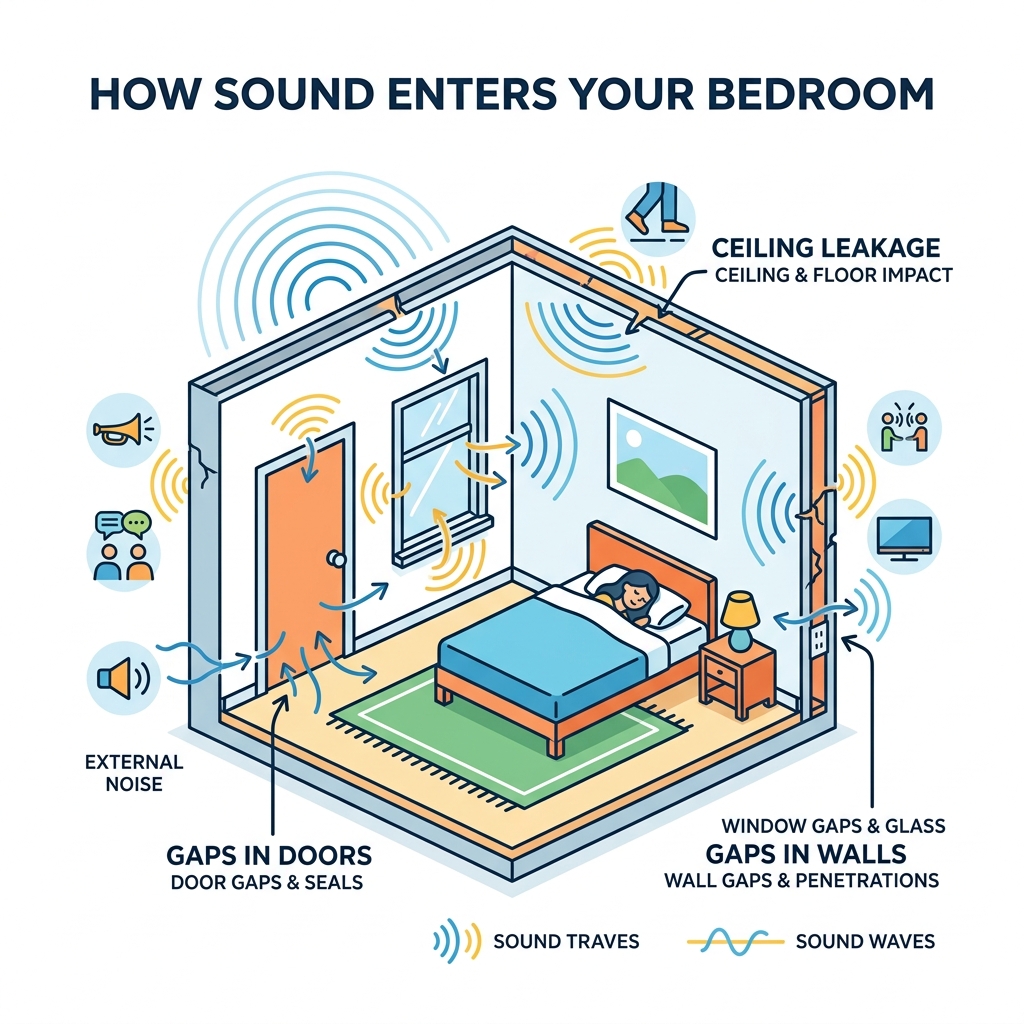
It’s 11:42 PM. You’ve just laid down after a long day. Then it starts — the upstairs neighbor dragging furniture, a car horn outside, or the low thump of bass bleeding through the wall. Sound familiar?
You’re not alone. Research from the National Sleep Foundation shows that chronic noise exposure above 40 decibels raises cortisol levels, disrupting sleep quality even when it doesn’t fully wake you. The American Academy of Sleep Medicine puts the danger threshold even lower — sounds above just 35 decibels can fragment your sleep cycles.
The good news? You don’t need a full renovation to fix it.
By layering a few affordable, targeted solutions, most people can cut bedroom noise by 15 to 25 decibels — enough to turn a disruptive environment into a genuinely restful one. Budget fixes start as low as $50, and many effective methods use items you already own.
This guide walks you through exactly what works, what doesn’t, and how to prioritize your efforts based on where your noise is actually coming from.
Soundproofing vs. Sound Absorption: Why the Difference Matters
Before we start dragging furniture around, we need to clear up a common misunderstanding that costs people a lot of money and frustration. There is a massive difference between soundproofing and sound absorption.
If you’ve ever seen a YouTuber with those cool-looking foam triangles on their wall, you’ve seen sound absorption. These materials are designed to reduce echoes and “clean up” the sound inside a room. They are great for recording a podcast or making sure your voice doesn’t bounce around during a Zoom call, but they are notoriously bad at blocking your neighbor’s loud TV.
Soundproofing, on the other hand, is about blocking the transmission of noise from one space to another. To do this effectively, you need three things:
- Mass: Thick, heavy materials that sound waves can’t easily vibrate.
- Damping: Materials that “soak up” vibrations (think of a hand touching a ringing bell).
- Decoupling: Creating a physical gap so vibrations can’t travel through the structure of the house.
For a bedroom, we usually need a mix of both. We want to block the hallway chatter (blocking transmission) and we want to stop our own snoring from bouncing off the bare walls (absorption). Understanding these Bedroom Noise Reduction Techniques on a Budget helps us choose the right tool for the job. If you want to dive deeper into the basics, check out our guide on Easy DIY Soundproofing Hacks.
How to Start soundproofing bedroom on budget: Assessment and Sealing
The biggest mistake we see is people buying expensive “acoustic” products before they’ve even looked at their door. Think of sound like water in a leaky boat. You can have the thickest hull in the world, but if there’s a one-inch hole at the bottom, you’re still going to sink.
In acoustics, we call this the 1% gap rule. Research shows that a gap as small as 1% in a barrier can leak up to 30% of the sound. If that gap grows to 5%? You’re losing 90% of your sound protection.
Noise Mapping
Start by “noise mapping” your room during a quiet hour. Stand near the window, then the door, then the shared wall. Where is the sound loudest?
- The Candle Test: Hold a lit candle near the edges of your windows and doors. If the flame flickers, you have an air leak. Where air goes, sound follows.
- The Light Test: At night, turn off the lights in your bedroom and have someone turn on the lights in the hallway. If you see light bleeding under or around your door, you have a massive noise leak.
Targeting these Window Soundproofing Solutions That Won’t Break the Bank first will give you the most “bang for your buck.”
Identifying Weak Points: soundproofing bedroom on budget Door and Window Checks
Most modern homes are built with light materials that act like a drum. Your bedroom door is likely a hollow-core door—essentially two thin sheets of wood with air and a bit of cardboard in the middle. These are terrible at blocking sound.
To fix this on a budget, we focus on the seals.
- Acoustic Caulk: Use a product like Big Stretch or a dedicated acoustic sealant (around $8–$10 a tube) to seal the gaps between the window/door frames and the wall.
- Weatherstripping: Apply self-adhesive foam tape (like 3M or Frost King) around the entire inner frame of the door. When you close the door, it should feel snug. This simple step can reduce noise by up to 15 decibels.
- Door Sweeps: A Suptikes door draft stopper or a heavy-duty rubber sweep seals the massive gap at the floor. This alone can cut noise infiltration by 30–40%.
For more details on sealing your entrance, see our article on Soundproofing Doors Without Overspending.
Maximizing Density: soundproofing bedroom on budget with Household Items
Once the air leaks are sealed, we need to add mass. If you can’t afford a $300 solid-wood door or a $500 window replacement, you can “fake” the mass using Homemade Methods for Soundproofing.
- Mass-Loaded Vinyl (MLV): This is a heavy, flexible material that you can hang over a door or wall. It’s a bit more industrial-looking, but it can cut noise by 15-20 decibels.
- Moving Blankets: These are thick, quilted blankets used for protecting furniture. Hanging one over your door or window is a classic renter hack. They are surprisingly effective at absorbing mid-to-high frequency sounds like voices.
- Upholstered Headboards: If you share a wall with a noisy neighbor, a plush, fabric-covered headboard acts as a tiny buffer between your ears and the wall.
High-Impact DIY Hacks for Walls, Floors, and Windows

Now let’s talk about the “big” surfaces: the walls and floors. If you’re hearing your neighbor’s TV or the “thud-thud” of footsteps from above, you need a different strategy.
The Power of the Bookshelf
One of the most effective, no-cost soundproofing hacks is the fully loaded bookshelf. A 6-foot bookshelf, packed tight with books of varying sizes, can reduce sound transfer through a wall by up to 25%. The paper in the books provides mass, while the uneven surface of the book spines helps break up sound waves (diffusion).
Pro Tip: Don’t leave gaps! Fill every inch. If you have a shared wall with a noisy neighbor, line that entire wall with bookcases for a massive DIY sound barrier.
Cost vs. Performance: Budget Materials
| Material | Typical Cost | Estimated Noise Reduction | Best For |
|---|---|---|---|
| Acoustic Caulk | $8 – $15 | 3 – 5 dB (sealing leaks) | Small gaps/cracks |
| Weatherstripping | $10 – $20 | 5 – 15 dB | Doors & Windows |
| Door Sweep | $15 – $25 | 5 – 10 dB | Bottom of doors |
| Thick Area Rug | $50 – $150 | 3 – 5 dB | Echo/Impact noise |
| Soundproof Curtains | $35 – $70 | 5 – 10 dB | Street noise |
| Bookshelf (Full) | $0 – $100 | Up to 25% reduction | Shared walls |
| MLV (Roll) | $75 – $150 | 15 – 20 dB | Blocking heavy noise |
Furniture Placement
Sometimes the best soundproofing is just a bit of interior design.
- Move your bed away from the shared wall or the window.
- Place a large, heavy wardrobe against the wall where the noise is coming from.
- Use “soft” furniture like bean bags or upholstered chairs in the corners of the room to catch echoes.
According to Scientific research on environmental noise and sleep, even small reductions in ambient noise can significantly improve the time it takes to fall asleep. If you’re looking for a quick fix for a single wall, consider Blanket Soundproofing: A DIY Approach.
Renter-Friendly Window and Floor Upgrades
If you rent, you can’t exactly tear down the walls to add insulation. You need “non-destructive” options.
Windows are usually the weakest link for outside noise.
- Soundproof Curtains: Brands like NICETOWN offer triple-weave blackout curtains that are surprisingly heavy. While they won’t block 100% of a siren, they can drop street noise by 5–10 decibels. For the best result, use a “double layer”—one sheer and one heavy drape.
- Window Inserts: If you’re handy, you can make a “window plug” using a sheet of MDF or plexiglass and some weatherstripping. Professional inserts can block up to 70% of noise, but a DIY plexiglass version can still achieve a 60% reduction for under $70.
Floors are about stopping “impact noise.”
- The Rug + Pad Combo: A higher pile on a rug only accounts for a 2% reduction in sound. The real magic is in the rug pad. Use a 1/2-inch dense felt pad or a memory foam pad under your rug. This combination can reduce footstep echo by 40–60%. Check out our Affordable Floor Solutions for Better Soundproofing for more ideas.
Wall and Ceiling Treatments for Shared Spaces
If you’re dealing with “airborne noise” (talking, music) through walls, you need to soften the reflections.
- Acoustic Panels: You can buy 12-packs of foam panels for about $35. Use Command Strips to hang them so you don’t ruin the paint. Just remember: these stop echoes; they don’t block the neighbor’s shouting.
- DIY Rockwool Panels: If you want professional results on a budget, buy a bag of Rockwool Safe’n’Sound insulation (~$60). Wrap pieces in cheap fabric and put them in a wooden frame. These are significantly more effective than foam.
- Ceiling Tiles: For upstairs neighbors, Art3D ceiling tiles can absorb 5-10 decibels of impact sound. They are lightweight and can often be stuck directly to the ceiling.
For more tips on treating your space for under a hundred bucks, see our guide on Acoustic Treatment for Under $100.
Frequently Asked Questions about Budget Soundproofing
Is it possible to soundproof a rental bedroom without damage?
Absolutely! We recommend using “tension” based solutions (like tension rods for heavy curtains), Command Strips for acoustic panels, and removable weatherstripping tape. Drafting stoppers that slide onto the bottom of the door are also great because they require zero adhesive.
Do white noise machines replace physical soundproofing?
They don’t replace it, but they complement it beautifully. While soundproofing blocks the noise, white noise (or brown noise for low-frequency rumbles) raises the “noise floor” of your room. This makes sudden sounds—like a car door slamming—less jarring to your brain, helping you stay asleep.
What is the cheapest material to block neighbor noise?
If you have $0, the answer is rearranging your furniture. Move your closet or bookshelf to the noisy wall. If you have $20, the answer is weatherstripping and a door sweep. Sealing those air gaps is the single most effective thing you can do for the least amount of money.
Conclusion
At TechAvanco, we believe your bedroom should be a sanctuary, not a echo chamber for the rest of the world. Soundproofing a bedroom on a budget is about strategy, not just spending.
Don’t try to do everything at once. Start with the “low-hanging fruit”: seal the gaps around your door and window. Then, add mass with curtains and rugs. Finally, treat the walls with bookshelves or panels. By layering these methods, you can progressively build a sleep sanctuary that protects your health and your peace of mind.
You don’t need “studio-level” silence to see a massive improvement in your sleep quality. Even a 10-decibel reduction—which is easily achievable with a few DIY hacks—can make a room sound twice as quiet to the human ear.
Ready to take the next step? Explore more info about DIY soundproofing and start reclaiming your quiet tonight!
